

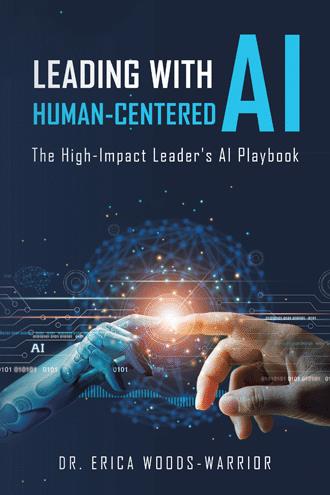
Leading with Human-Centered AI
The High-Impact Leader's AI Playbook
by
Book Cover & Preview Text
Chapter 7: Prioritizing the Human Element: Emotional Intelligence in the AI Era As AI becomes increasingly integrated into the workplace, a critical question emerges: how do we ensure that technology enhances, rather than diminishes, our human capabilities, particularly emotional intelligence (EQ)? Leaders must proactively cultivate an environment where AI serves to amplify human connection, empathy, and well-being, rather than creating a cold, purely transactional work environment. The more we automate with artificial intelligence, the more we must lead with emotional intelligence. AI as an Amplifier: How AI Can Enhance Human Emotional Intelligence and Decision-Making While AI itself does not possess emotions, it can be a powerful tool for enhancing human emotional intelligence. AI-powered tools can analyze communication patterns, sentiment, and even physiological cues to provide leaders and teams with insights into emotional states. This data can then inform more empathetic responses and better decision-making. For instance, AI can analyze team sentiment across communication platforms (e.g., Slack, email) to flag potential issues like burnout or low morale, allowing leaders to intervene proactively. This augmentation extends to our emotional capabilities, providing data points that can inform and refine our human interactions. AI can also assist in: • Personalized Coaching: AI-driven coaching platforms can provide real-time feedback on communication style, tone, and even suggest empathetic phrasing for difficult conversations, allowing leaders to practice and refine their EQ skills in a safe environment. • Understanding Diverse Perspectives: AI can help leaders tailor messaging by providing insights into how different demographic or cultural groups might perceive a message, enhancing inclusive communication. • Identifying Emotional Trends: By analyzing large datasets of interactions, AI can help identify patterns of customer frustration or employee stress, enabling organizations to address systemic issues with greater empathy. Preserving Human Connection: Ensuring AI Supports, Rather Than Detracts From, Empathy and Interpersonal Skills The risk of over-reliance on AI is that it could lead to a decrease in genuine human connection and the erosion of essential interpersonal skills. Leaders must actively design workflows and foster a culture where AI complements, rather than replaces, human interaction. It is important to remember that although machines can use voice analysis techniques and analyze facial expressions to categorize emotions by speech characteristics, understand human emotion, and even react to it, they cannot replicate human emotion. The key is to leverage this recognition to inform human action, not to offload the responsibility of empathy to machines. Strategies for preserving human connection include: • Defining Human-AI Collaboration: Clearly delineate tasks where human empathy and judgment are irreplaceable (e.g., complex problem-solving, sensitive customer interactions, conflict resolution) versus those suitable for AI automation. • Encouraging Face-to-Face/Voice Interaction: Despite the efficiency of AI-powered communication, leaders should actively promote and create opportunities for direct human interaction, whether in-person or via video calls, to build rapport and trust. • Training for Human-AI Teaming: Equip employees with skills to effectively collaborate with AI, understanding its strengths and limitations, and knowing when to override or seek human intervention. • Transparent AI Usage: Be open about when and how AI tools are being used, ensuring employees and customers understand they are interacting with technology and that human oversight is maintained. Cultivating an EQ-Driven AI Culture: Leading with Self-Awareness, Empathy, and Social Skills in an AI-Augmented Workplace. Ultimately, humanizing AI is about cultivating an organizational culture that prioritizes emotional intelligence. This means leaders must embody and promote self-awareness, empathy, and strong social skills, serving as role models for how to thrive in an AI-augmented environment. Amit Ray, an AI researcher and author, suggests, "As more and more artificial intelligence is entering into the world, more and more emotional intelligence must enter into leadership." This is the core challenge and opportunity for leaders in the AI era. To cultivate an EQ-driven AI culture: • Lead by Example: Demonstrate emotional intelligence in your own interactions, showing how you integrate AI tools while maintaining genuine human connection. • Invest in EQ Training: Provide training programs that focus on developing emotional intelligence skills for all employees, from frontline staff to senior leadership. • Create Safe Spaces for Feedback: Encourage open dialogue about the emotional impact of AI, allowing employees to voice concerns and contribute ideas for human-centric solutions. • Recognize and Reward EQ: Acknowledge and celebrate behaviors that demonstrate high emotional intelligence in the context of AI adoption and collaboration. By consciously prioritizing the human element and fostering an EQ-driven culture, leaders can ensure that AI becomes a powerful force for good, enhancing productivity, fostering innovation, and strengthening the human connections that are the true bedrock of any successful organization. Powerful Reflection Questions for Leaders 1. How are we enabling our team members to become more skilled and knowledgeable? 2. Beyond formal training, what day-to-day practices do we have in place to encourage a culture of continuous learning? 3. How do we empower your team to experiment with new technologies without the fear of failure?
Select Format

Book Details
About the Book
LEADING WITH HUMAN-CENTERED AI: THE HIGH-IMPACT LEADER'S AI PLAYBOOK A defi nitive strategy manual for executives—whether in the private sector pursuing competitive advantage or the public sector driving mission success and governance. It provides a blueprint for pioneering a future where human ingenuity is amplifi ed, not superseded, by technology. The book introduces an innovative and simple framework for implementing human-centered AI, and uses examples from every industry to provide a pragmatic roadmap. You will move beyond algorithmic hype by systematically identifying AI opportunities that drive measurable impact, then forge an adaptive AI strategy rooted in robust data governance and security. This is the only book that truly centers on the transformation's most critical asset: your people. You will master effective change management and the strategic imperative of prioritizing the human element. Crucially, you will learn to build and deploy systems guided by strict ethical AI principles, ensuring fairness, transparency, and accountability across your organization. Each chapter identifi es key challenges, viable solutions, and powerful questions every leader must consider before and after adopting the use of AI. The im perative for executive action is now: Move beyond reactive engagement and strategically architect a future of ethical growth and institutional resilience. This framework is the essential guide for transforming AI into a sustained and governed source of organizational excellence.
About the Author
Dr. Erica Woods-Warrior is an expert in Organizational Development with over 20 years of experience helping organizations navigate the complexities associated with improving systems and building human capital. Driven by a passion for increasing human capacity within organizations, Dr. Woods-Warrior wrote Leading with Human-Centered AI to bridge the gap between the haphazard or disjointed use of artificial intelligence and actually leveraging AI to enhance the mission and outcome of every team. When not writing or consulting, Dr. Woods-Warrior can be found exploring the world through travel and art.