

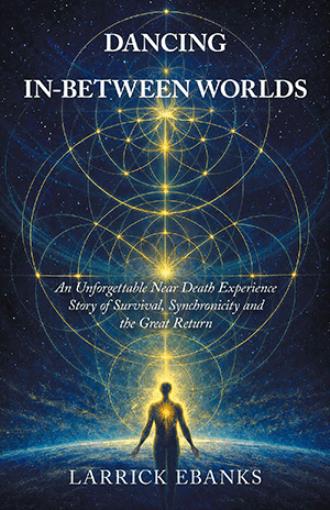
DANCING IN-BETWEEN WORLDS
An Unforgettable Near Death Experience Story of Survival, Synchronicity and the Great Return
by
Book Cover & Preview Text
The Breath Between Worlds It was the winter of 2021. The island of Mallorca was just beginning to breathe again after the long pause of the global lockdown. Restrictions from Covid were easing, and life, though changed, was cautiously finding its rhythm. We were finally back in the office at the magazine, where I headed up the entertainment department and occasionally stepped into the journalist’s chair. It was a buzzing time, interviews with known names were coming in, invites to exclusive events landed in my inbox, and I was set to perform live on New Year’s Eve. On top of that, I was helping coordinate the magazine’s very first reality-show pilot. There was movement again. Excitement. Purpose. After so much stillness, the world felt like it was beginning to hum again. And I was right in the centre of it. I couldn't have predicted how my entire world would take such a turn. Nine days before I was taken to hospital, I hadn't been feeling well. I first noticed when I was called on stage to sing at my local bar and halfway through I was struggling for breath. The following days, riding my bicycle became a struggle, then night sweats, chills, and a slow loss of strength. I felt I could handle it, I thought I could meditate it away, though people around me said I looked unwell. My approach to life had always been spiritual, meeting the world with compassion and trying to see meaning in everything, yet the peace required to keep my mind and body in balance was being outweighed by the intensity of the breathlessness I was feeling. Earlier that week, I’d attended an event in town and stayed over at a friend’s apartment while he was away. As I walked back that evening, from the event, caught in the rain, a sudden chill rippled through my chest like never before, a pain so severe I knew something wasn’t right. I couldn’t get warm that night and made my way home the following morning, still shivering. My immune system was low, but I had commitments and deadlines, and I wasn’t about to let anyone down. The project was almost complete. I worked from home so I could stay wrapped up, convincing myself I’d be fine. In hindsight, I should have called a doctor sooner. My sister-friend Donna insisted I go to the hospital and eventually called an ambulance. According to the doctors, one more night at home and I would have been dead. I hadn't realised how close I was to the edge of something vast. I arrived at the hospital, laptop in bag as if I’d only be there a few nights. As I was wheeled to a bed, I heard a familiar voice: “I know him, He’s my friend, What happened?” It was Montse, a hospital worker I had once defended years earlier when others tried to push her out of a bar job I’d given her. Back then, as her manager, I told her not to quit, that she was more than capable. She stayed, but we lost touch — until now — Here she was, lifting my weak body into bed — In that moment, kindness circled back — Within twenty-four hours, concern was written all over the doctors’ faces.\nBy hour forty eight, I was in ICU on high-dose oxygen.\nMy lungs were not simply infected — they collapsed, hardened, scarred, filled with fluid, and needed to be drained repeatedly. I was closer to death than I realised.\nA doctor asked, “How are you feeling, Larrick?” I answered, “I’m OK,”\nHer reply cut through: “You just don’t realise how serious this is.” Then everything changed.\nThere was no time to figure it out. No gradual preparation.\nWhat happened next, I witnessed from the outside, because it took eight doctors surrounding my bed to make the decision to induce me into a coma and connect me to the ECMO machine (extracorporeal membrane oxygenation system). This machine, used only in the most critical cases, takes over the work of the lungs and heart, drawing blood from the body, infusing it with oxygen, removing carbon dioxide, then sending it back again, giving failing organs a chance to survive. There was a shortage on the island; mine had to be flown in from Barcelona. Tough choices had to be made about who would be given access to one of these life-saving machines. I was chosen because of the severity of my illness, and because, as a regular gym-goer, my body might endure what others could not. To them, it was a medical necessity. To me, it became the beginning of everything. I don’t remember the collapse itself. Not in the way we usually remember things. There was no scream. No falling. No moment of panic as the doctors induced me into a coma. What I initially thought was three days became three months. There was a strange shift in awareness, some excruciating body pains, and a deep wanting for it to stop. From that moment, I was no longer in a body. I had entered a whole new reality. Then a voice: “This is an endurance test. You have to make your way back to Planet Earth.” The words weren’t spoken aloud. They were placed inside me—telepathic and crystalline. When the voice first landed inside me — “This is an endurance test” — it turned like a key in a lock. The world I had known contracted to a pinpoint: tubes, machines, clinical light. Then something else opened — a corridor of sound and colour that moved faster than language and steadier than thought. I stepped through without the things that once defined me. I stepped into a curriculum of the soul. The realms I encountered were not a single place but a sequence of thresholds. Each threshold had a tone. Some were low and dense, heavy with accusation and old hurts; others were bright and crystalline humming with clarity. I learned quickly that frequency mattered more than geography. Move toward a tone and the landscape shifted. Lean into compassion and the ground became soft and forgiving. Fear contracted everything; love expanded it. How do you move when there is no floor beneath you? How do you hold balance when balance itself is dissolving? It was as if gravity had been replaced by intention. I began to dance, though my body was nowhere. The dance was a conversation: gravity offered me memory; light offered me possibility. My task was to weave them together, step by step, pulse by pulse, without losing myself.
Select Format

Book Details
About the Book
This book is not merely a story of survival. It is a transmission from beyond the veil—an echo of soul, sent back to remind us of what is possible when we are cracked open, tested beyond what the body and mind can comprehend, and reassembled with a new kind of light. Much of what I will share here came through the energetic realms during that time. Some experiences were dark and challenging initiations. Others were radiant, wrapped in angelic wings, surrounded by love so profound it broke the very definition of self. One thing became clear: my ability to navigate this space depended entirely on my frequency. One of the first things I heard telepathically was: "This is an endurance test." And so I endured. I was taught to listen differently, to breathe differently, to feel my way forward. I was given keys, symbols, and teachings. I remembered my childhood magic, the purple wizard hat, and I remembered my mission. What follows in these chapters is my offering. These are the things I was shown, piece by piece, day by day, breath by breath. This is the voice of someone who didn't just survive death. This is the voice of someone who danced in-between worlds and returned with the music. And now, together, we begin.
About the Author
Larrick Ebanks is a UK singer-songwriter, developing journalist, inspirational speaker, and former live music and DJ venue owner, whose life and work have been shaped by creativity, resilience, and human connection. Larrick released his debut single What You Give Me in 1997, leading to a publishing deal with Warner Chappell Music, the company that continues to publish his songs today. In 2016, he independently released his first and only album, Larrick Through The Looking Glass 1986–2016, spanning three decades of songwriting, from his early band years with The Catch working alongside renowned record producer Bob Lamb to his later solo material. Over the years, Larrick has performed at notable venues both as a solo artist and as a backing vocalist for established artists. Alongside music, Larrick moved into journalism, where his interest in people and storytelling opened the door to interviews with respected DJs, singers, and public figures. Today, Larrick is passionate about creating heart-led gatherings that combine music, conversation, inner awakening, transformation, renewal, alignment and shared human connection, spaces designed to uplift the spirit and remind people of the deeper essence that unites us all. Bandcamp: https://larrickebanks.bandcamp.com/ Instagram - Facebook @larrickebanksofficial #dancinginbetweenworlds