

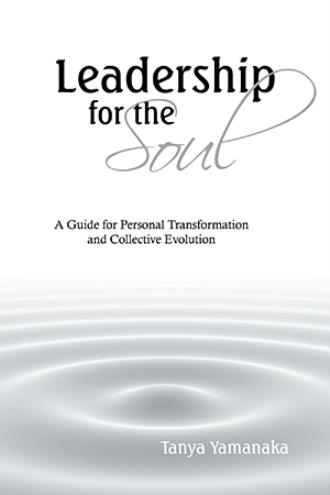
Leadership for the Soul
A Guide for Personal Transformation and Collective Evolution
by
Book Cover & Preview Text
The question to ask ourselves is, how do we cultivate this kind of leadership in others? How do we become this kind of leader ourselves? I only know what has worked for me. I embarked on the great adventure of self-knowledge through self-inquiry and self-contemplation. In this kind of quest, we explore the depth of who we are by: Recognizing our addiction to separation; Understanding the power of our perception; Learning about and practicing skilled perceiving; Listening to and trusting the guru within; Exercising the superpowers of the heart (the Four C’s); Adopting a curious and wonder-full mindset; and Using the Seven Senses of the Mind. We then learn how to share these discoveries with those around us by: Shifting our focus from “me” to “we;” Recognizing the full extent of human potential; Prioritizing cooperation over competition, connection over disengagement, and service over self-interest; and Crossing the threshold into leadership for the soul. We emerge from this journey as a Soul Model, ready and eager to serve as a transformational leader. What is a Soul Model? In short, a Soul Model may be anyone, regardless of role, title, or gender, who commits to living in conscious relationship with their eternal essence beyond their earthly personality, who serves as a role model for conscious evolution and purposeful transformation. More specifically, a Soul Model embodies the following characteristics and capabilities: Wholeness. Increasingly in modern life, we feel disconnected from our truest selves and separated from each other, but Soul Models recognize division for the illusion it is. They focus steady attention on the beliefs, emotions, thoughts, and actions that create separation and then consciously recalibrate their perception toward wholeness. Chapter 1 discusses the modern addiction to separation and how we can begin to see the truth of interconnectedness. Skilled Perceiving. Our sensory experience of the world—our perceptions—are the primary way we define ourselves, others, and our environment. But our perceptions are much more limited than we realize, and a Soul Model knows this. She can identify self-deception in her own life and consciously choose the types of perception that allow her to see the exterior world more objectively. This type of skilled perceiving, covered in Chapter 2, is an essential part of leadership for the soul. Inner Resonance. Soul Models work to develop the capacity to lead with truth while remaining compassionate. They strive to lead with love while staying grounded and impartial. Their purpose is service to all, which requires profound trust in the guru within, the inner master teacher. The Four C’s, which we’ll explore in Chapter 3, are the pathway to developing inner resonance and heart-centered response-ability. Curiosity and Wonder. Once we become adults, we often abandon our childlike sense of wonder and imagination in favor of predictability, education, and judgment. A Soul Model resists this and instead embraces self-discovery and transformation with openness, curiosity, and excitement. He leaps into the unknown with a willingness to examine his sense of reality and face the strange, paradoxical parts of himself. The Seven Senses of the Mind, which we’ll cover in Chapter 4, are the frameworks for this exploration. They invite us to surrender to wonder and peel back layers of social and mental programming so we can awaken to the truth of who we really are. Oneness. Humanity is fundamentally and irrevocably interconnected. Thus, leadership for the soul is inherently relational and collective. Soul Models help unlock the fullness of human potential by insisting on Oneness—cooperative, nurturing, life-giving unity and reciprocity. In Chapter 5, we will challenge the individualism that limits our growth by considering how we each shape and are shaped by the whole. Stewardship. A Soul Model is a visionary leader who values communal flourishing as much as individual authenticity. She lives, leads, and creates with self-awareness, compassion, service, intuition, resilience, and purpose, prioritizing the greater good over ego or power. Chapter 5 looks at how Soul Models can serve as both catalysts and architects for a more conscious, loving, and interdependent world. Courage. Becoming a Soul Model is not a one-time event but an ongoing act of courage—a daily willingness to embrace uncertainty, to let love (not fear or apathy) guide our perception and action, and to live from wholeness rather than unconscious conditioning. Crossing this threshold into soul leadership, as we explore in Chapter 6, is a lifelong return to Source, remembering that divinity is everywhere, in everything, and within us. Who This Book Is For and How to Use It This book is for emerging leaders and activists, empaths and sensitives, light workers, healers and seers, and anyone who wants to be an integral part of humanity’s transition out of 19th and 20th century systems into a new era focused on self-agency, freedom, illumination, and wholeness. It is for those who wish to be self-actualized and community-supported, who desire to embody the fullness of their humanity and divinity. Leadership for the Soul is at its essence a framework to use contemplatively to find your own sense of purpose, meaning, and right living. It is an escort to realizing and openly expressing the reality of Oneness, the truth that “I am because we are.” It teaches you how to nurture your soul—not just for the benefit of your inner world (Convergence of Being) but for the gift you can give to your outer world as a Soul Model (Emergence of We-ing). As such, it is not a rulebook or a set of how-to steps. It is instead a companion for your journey toward spiritual mastery as you live into your calling as a transformational leader.
Select Format

Book Details
About the Book
Leadership for the Soul is an invitation to remember who we are—and how to lead from wholeness—at a pivotal time of personal and collective change. Blending personal story, philosophy, and practical guidance, Tanya offers a soul-centered approach to cultivating skilled perception, presence and self-leadership grounded in belonging and deep inner listening. Rather than prescribing formulas or hierarchies, Leadership for the Soul guides readers inward—to the inner guru and the quiet intelligence of the heart. Through original frameworks such as the Seven Senses of the Mind, the Four C’s: Superpowers of the Heart, and Soul Models, the book explores how resonance, imagination, and self-inquiry can transform how we perceive ourselves, relate to others, and lead within a complex world. At once reflective and practical, Leadership for the Soul offers readers both language and lived practices for becoming Soul Models—leaders who remember, embody, and activate the wisdom needed for these times. Grounded in place, story, and lived experience, the book bridges inner work and outer action, inviting empaths, healers, community advocates, changemakers, and seekers to cross a living threshold from “me” to “we” to “all.”
About the Author
Tanya Yamanaka is a mother and grandmother living on the Big Island of Hawaiʻi. A community advocate, writer, and healer, she explores the journey of the Soul Model: leadership as a path toward wholeness, belonging, and collective transformation. Rooted in place, relationship, and lived experience, she offers a grounded perspective on what it means to lead in times of profound change.
Drawing inspiration from Hawaiʻi’s landscapes, culture, and political movements, Tanya explores leadership as remembrance—of belonging, responsibility, and our shared humanity.