

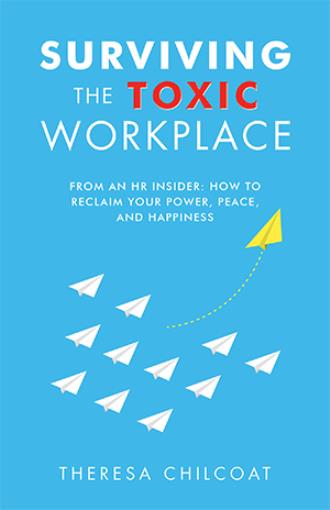
Surviving the Toxic Workplace
From an HR insider: How to Reclaim your Power, Peace, and Happiness
by
Book Cover & Preview Text
Show me someone who hasn’t worked in some type of toxic workplace, and I’ll show you a purple unicorn. I know I am not alone in this dilemma. I have heard repeatedly from employees and friends working in other organizations just how toxic the workplace has become. A manager screaming at an employee in front of the team. The group of coworkers that “ice out” anyone who hasn’t been with the company more than five years. The boss who comes into work locks themselves in their office all day and doesn’t speak to anyone. Or the sales manager’s inappropriate behavior that should get him fired but isn’t held accountable for his actions because he’s the top salesperson every month. I wish I was making up this cast of characters for shock and awe, but I’ve personally encountered each one of them. I have heard horror stories from many others with their own cast of characters who are tolerated within different organizations. Wouldn’t it be great if you could ask during the interview process, “What is the level of toxic behavior that exists within the organization?” For example, if you could ask: • “On a scale of one to ten, one being Zen-like and ten being the Star-Spangled Banner of toxic red flags, how would you rate your company’s level of toxicity?” • “How many employees have left the company specifically because their manager was impossible to work with?” • “Does your company have a group of mean girls?” • “How many of your managers are part of a clique that puts a new hire through a hazing ritual before they can be considered part of the in group”?” For every position I interviewed for, I thought I had asked the right questions to get a sense of what the company culture was like. But how much can you really know about a company until you accept the position and start working? There’s nothing more disappointing or gut-wrenching than discovering that the company you were so excited to work for is really a three-alarm dumpster fire. Working in human resources for nearly twenty years, I can’t count how many articles I have read about the importance of company culture and how it factors in with employee engagement, employee satisfaction, and employee turnover. It seems like every week there’s another publication highlighting the importance of company culture. At this point, I just roll my eyes at these researchers preaching to the void. I have also heard tireless accounts of the direct correlation between how organizations treat their employees and the impact on customer and client satisfaction. But why are more organizations not focusing on company culture if it is supposed to be so important? When I was looking for literature or studies on toxic leadership, there were very few articles written about the topic until about ten years ago. Most of the literature and research has been done on positive leadership, how to build a strong leadership team, and the signs of great leadership. These articles are a great resource if you have an organization that recognizes the importance of great and effective leadership. Unfortunately, there seems to be a high percentage of organizations that don’t seem interested in the importance of positive leadership and the effects that poor leadership behavior has on the company culture. I don’t know about you, but when the pandemic hit in March of 2020, we were sent home to work for maybe two weeks, three weeks tops. As the pandemic progressed through 2020 and into 2021, I didn’t go back to the office, and neither did a significant number of workers in the U.S. I discovered that organizations were not prepared for employees to work from home as long as they did. It seemed as if companies were on standby, waiting for everything to return to normal. But did it? Based on my research, things didn’t return to normal, and the workplace hasn’t gotten better. I know a high percentage of employees who ended up working from home indefinitely until just recently. Four years later, they now want these same employees to return to the office and can’t understand their reluctance to do so. Employees are experiencing a larger sense of detachment from their employers than they did four years ago. The impact of these behaviors has led to employees feeling detached from their employers and less satisfied with the organization they work for. This leads to feelings of isolation and anxiety about not knowing what is expected of them in their role, leading them to look for another position. Many employees don’t feel like anyone at work cares about them as a person, which causes them to be less engaged at work. In Gallup’s 2024 report, “The Great Detachment: Why Employees Feel Stuck,” employee engagement reached an eleven-year low, and employees are seeking new job opportunities at the highest rate since 2015.1 Personally, I didn’t think things were getting better in the workplace regardless of the number of articles I read, and these statistics confirmed that the workplace hasn’t gotten any better since COVID-19 pandemic. I thought it was just me experiencing the high levels of toxic behaviors in the workplace. When working in human resources, I was looking at the leadership team to recognize what was happening within the work environment and trusted they were working on formulating a plan to address these issues. Unfortunately, in the last four years, the statistics on mental health and the support provided in the workplace for mental health issues haven’t improved either. I’m providing all this information to confirm what you probably believe is happening to you. This is to reaffirm that you are not crazy. What you are experiencing in the workplace really is happening, and you are not alone in how you feel about how bad the environment has become.
Select Format

Book Details
About the Book
You’re not imagining it – and you’re not alone. If your workplace drains energy, erodes confidence, and leaves you questioning your worth, it’s time to move past dysfunction and decide what’s next, with clarity instead of fear. Packed with real stories, practical tools, and empowering insights, this book is your roadmap to power, peace, and happiness. It will guide you to what you truly deserve: peace, purpose, and a way forward. Theresa Chilcoat, a human resources strategist and leadership coach, delivers practical strategies and research-backed insights to expose the myths that keep people stuck. Discover how to: • determine whether you’re working in a toxic environment; • control how you react to what is happening around you; • reclaim your energy, voice, and joy – even when the culture is working against you; • stop merely surviving your job and take control of your well-being and future. Surviving the Toxic Workplace is a rally cry for anyone ready to stop shrinking and start healing, so they can enjoy a life and career that feels like theirs again.
About the Author
Theresa Chilcoat, MS, PHR, SHRM-CP, has spent over fifteen years in human resources with an emphasis on employee relations and leadership training. She has spent the last six years of her career in the health-care sector, providing valuable insight and coaching to managers, executives, and physician leadership. Theresa continues to provide valuable coaching that empowers individuals to unlock their potential as a Purpose Factor® licensed facilitator providing personalized guidance, self-reflection, and strategic goal setting to help people gain clarity while navigating the challenges of managing the ever-changing work landscape. Theresa holds a Master of Science degree in strategic human resources from the University of Denver and a Bachelor of Science degree in business administration from the University of La Verne. She has been a member of the Dallas HR professional association since 2015 and holds a certification with the Human Resource Certification Institution since 2013 and a certification with Society of Human Resource Professional since 2015. Theresa lives in north Texas with her husband, Charles, and their two dogs, Mia and Chloe. When Theresa isn’t writing, coaching clients, or giving workshops, she enjoys hiking, yoga, and reading. To learn more, Theresa can be reached at: admin@theresachilcoat.com. LinkedIn: Theresa (Teri) Chilcoat Facebook: Teri Chilcoat Instagram: @tchilcoat