

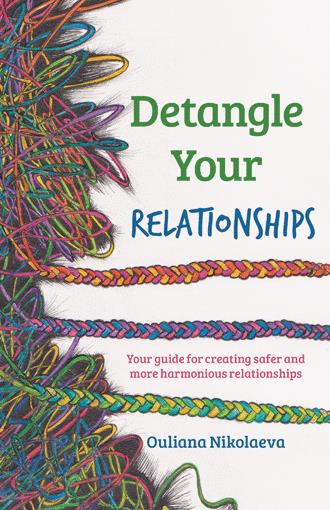
Detangle Your Relationships
Your guide for creating safer and more harmonious relationships
by
Book Cover & Preview Text
Chapter 1: Relationships in Human Experience What Is Life? The question ‘What is life?’ may push some of us to roll our eyes, as philosophers across history haven’t been able to give us a clear answer. Stay with me though; this may get interesting. A child is born. They’re born someone—a boy or a girl with their own set of physical traits and their own set of preferences that they have yet to discover. As soon as the baby leaves their mother’s womb, they get introduced to people: their mother and perhaps a few other individuals assisting their arrival into the bigger world. The baby grows, discovering how they feel about their environment: their caregivers, food, bedding, light, temperature, and their own needs. This determines how they will react at any given moment. They learn to relate to their own body, emotions, people, objects, and their environment. They grow further, learning skills and manners. They learn that some of their behaviours are deemed unacceptable, and in order to keep their relationship with the caregivers stable, they must give them up. It is understood that an infant is not able to take care of itself. Even a newborn baby knows instinctively that it’s thanks to their caregivers that they have a better chance at surviving. Hence, they adapt and learn to relate in a way that guarantees them love and acceptance. It is the way that child relates to their classmates that will determine whether they belong in a group. The way they relate to their physical appearance will influence their attitude, their style, or their will to hide and never come out of their room. The way they relate to teachers, the learning system, and the taught knowledge will dictate their academic success. The way they relate to the weather, daily news, and strangers on the street affects their mood. The way they relate to money will influence their income choices and spending habits, leaving them wealthy or broke. You get the point. I have overly simplified the cause and effect here for the sake of demonstration. As you’ve probably noticed, relationships are everywhere. They’re in the way we relate to ourselves, to people around us, to events and situations that we create—well, our lives. The lives we create for ourselves influence the way we relate in return. To say that relationships are everywhere is an understatement; they are the core of human experience. In this book, however, we will focus on relationships between people. We, humans, are extremely relationally dependent. We may feel like we can do it all by ourselves and we don’t need anyone, but let’s just look around: somebody else wrote the book you’re reading, another person conceived the fridge you keep your snacks in, some other person (probably) designed the sofa you’re sitting on, the food you ate this week was grown and harvested by several other people, and so forth. How far would we honestly go alone? Biological Incentive If our biology prompts us for survival, it does so by showing us the importance of relationships. I’ll illustrate this with an example. Imagine that I prepare a very kind note for my colleague Bob and put it on his desk for him to discover when he arrives at the office. As I write this note, my brain secretes oxytocin, commonly known as the ‘love hormone’. It gives me a lofty feeling, and according to science, it even helps me improve my overall health. Bob arrives at the office and notices the cute piece of paper with kind words on it, and a big smile appears on his face. His brain also secretes oxytocin, so we’re now two happier and healthier individuals in that office. If you are lucky enough to be there, too, and to witness that act of kindness, guess what? Your brain will make you join the club. Indeed, witnessing or even just thinking about an act of kindness makes our brains release this hormone. See how our biology encourages us to be kind to each other. Why is it important though? It is because we need each other and depend on each other for our own survival. I firmly believe that connection is the most important need for a human being. I know we’re used to believing that physiological needs rank higher on the essentials scale. However, have you ever experienced a severe weight loss after a break up or the death of a loved one, where sensations of hunger are simply out of reach? How many suicide attempts happen because of failed relationships? Indeed, we need people more than we would like to admit. As infants, we’re relationally dependent to the extreme compared to other species. As adults, we never grow out of needing others. While the incentive seems clear, we may wonder what went wrong with the human species. Why are there murders, rapes, robbery, and rudeness if our biology is programmed for kindness and connection? Trauma is the answer. I don’t just mean the extreme stuff—what is commonly called the ‘big T trauma’. I mean painful occasional or everyday occurrences in our childhoods that make us question our worth and our belonging. I wish I could explain the mechanism in one sentence. I guess this calls for another book. Isn’t it ironic that as relationally dependent as we humans are, most of our trauma is relational. Most of us have been through things like humiliation, rejection, and emotional neglect; very few have experienced tsunamis, earthquakes, and devastating forest fires.
Select Format

Book Details
About the Book
Even though people are all different, there’s a certain predictability to our behaviour. Relational patterns we follow are very common, especially within the same culture. This book helps understand the reasons behind these patterns, which gives the reader metadata of their own behaviour. Illustrated with stories from the author’s own life, her clients challenging moments and resolutions found in times of crisis, this collection of lessons acts as a user guide to human relations of any kind. Most of our relational dynamics are unconscious today, shaped by past experiences, emotions, and ingrained habits. Bringing these dynamics into awareness, detangling ourselves from harmful patterns and choosing to act according to our values is the beginning of the journey to creating healthier and more intentional interactions. In this book you’ll learn about the five ways of relating to each other, discover the detrimental nuances of independence, distinguish between love, appreciation and attraction, understand the mechanics of seduction and the importance of compatibility. Whether you use it as an instruction guide or a troubleshooting manual, the content of this book is aimed at helping you enhance fluidity in your social interactions and cultivate deeper enjoyment in your relationships.
About the Author
Ouliana has always been fascinated with human psyche. Born in Russia, she moved to Belgium at the age of 15. Observing cultural differences, she has always sought to understand what makes people behave in a certain way. Today she’s a teacher, coach and therapist, helping people reclaim their life story.