

Writing Through the Senses
A Joyful Way to Unlock Your Intuitive Voice
by
Book Cover & Preview Text
Once you can easily focus on the image, take it in fully. Absorb it. Spend some moments being with it with concentrated attention—take it in visually but also allow yourself to experience it with your body. Do you feel it somewhere particular? What is the first thing that affects you? Is it a color or texture? (These often go together.) Is it an emotion such as distaste or a feeling of happiness? Is it a quality—softness, perhaps, or alertness? Does the image feel noisy or silent to you? Cozy or scratchy? Soporific or jumpy? Do you have a visceral body sensation—perhaps it makes you feel off-balance, or perhaps you almost feel yourself moving with the quality of its sensuous lines. Do you resonate with the meticulous way its forms are rendered, or the looseness of the texture? What stays with you if you look away? Trust your impressions as a good starting point. If something hits you right away, begin right there: start writing. You might describe the softness, for example, or just make a list of words related to softness. You might write about something soft, even if it bears no relationship to the image in front of you. If the first thing that you connected with was the “pow” of the color red, write about red. Here too you can make an associative list to get you going—Little Red Riding Hood, a toreador’s cape in a bullfight ring, the bright red of a sugar maple in a New England autumn. You might associate red with anger, or love-hearts, or a sharp pain in the stomach. It doesn’t matter what it is; just use it as your starting point, your opening or doorway into the writing. Perhaps you can’t identify a feeling or definable reaction and are just feeling perplexed. That’s not a problem; you can use that as your doorway. Some part of you may feel that if you don’t know what it is (what it represents), you have nothing to say (write about). Trust that that’s okay. If you approach the image with curiosity and wonder, it doesn’t matter that you can’t “figure it out.” It’s wonderful to understand that you don’t know what you don’t know! With this attitude, you will be working from questions and feelings rather than assumptions. Your left brain can’t immediately take charge, and if you allow it, your other ways of knowing and processing will kick in. You can in fact engage with the image by directly asking it questions. One obvious way to begin would be to ask (in writing) “What (or who) are you?” Even better would be something like “what do you want to tell me today?” “What do you want?” Listen for the answer—wait for it—and whatever comes, write that down. Trust it and go with it. Even if it seems absurd or far afield, it’s your beginning. If it says something curious, ask it further questions. A dialogue of this sort may become lively, and it will probably elicit some things that surprise you. It’s a wonderful way of allowing what’s deep inside to come out, since your rational mind can’t predict what’s going to happen. If you slip into dialogue, write it on the page like a play or movie script, giving each “speaker” a different line and clearly distinguishing who is saying what. Although I have characterized this as a dialogue and recommend writing it that way, don’t comment too much on the answers; let the image do most of the talking, and refrain from getting into an argument with it. You needn’t work with the whole image. If certain elements stand out for you, just respond to them and direct your questions to what you are engaged by. Any part of an image may speak to you—a tree, a house, a piece of jewelry, even a person’s ear. You can also dialogue specifically with whatever you initially responded to; if it was the red color or the quality of softness, you can have a conversation with “Red” or “Soft.” Experiment with your inquiries. Beyond any literal story or representation, use questions to evoke an essence. Approach the picture or its individual parts as a character and pretend you are interviewing it. You might ask, “What do you eat for breakfast?” “What kind of music do you like?” “What are you afraid of?” You can turn to synesthesia-related questions for ideas, too. “What number are you?” “What room in a house?” “What time of day?” “What orchestral instrument?” Also consider the image from different vantage points. If it’s an abstract composition, turn it around in all directions and see what happens from each position. (This even works for some representational scenes.) Images have different effects when you look at them head-on, or from above or below. You can approach the image from the point of view of the artist or photographer. Who were they? Imagine what were they doing when they created the image. You can also focus on the different materials represented in the image, or the ways an object is constructed. If you began with the image of the pots in Figure 12, for instance, you might write about the sensation of handling smooth, circular forms. Your body would feel the rhythm and the roundness. If you find yourself immediately going into a story from a given image (this is especially likely if it includes people or animals), allow the story to tell itself to you, rather than telling it what it is. Explore—play—with different storytelling voices. Most stories are told by an omniscient narrator who knows what is going on, but you can take any voice. If there’s a tiger in that picture, let the tiger tell the tale.
Select Format

Book Details
About the Book
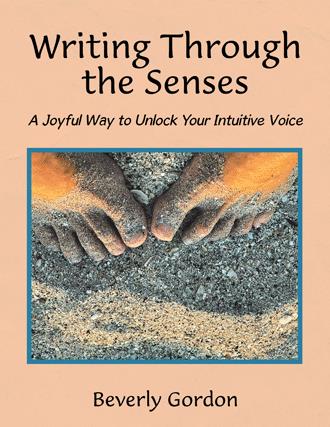
Experience a unique and fresh approach to creative writing by using sensory prompts--images, objects, tactile sensations, sound, movement, taste and smell--to guide your writing process. This way of working goes beyond language and linear thinking, leading to more intuitive, embodied ways of knowing. This book will help you increase your awareness of the richness of life and foster a sense of possibility, joy and confidence, all of which you can bring to your work. While not a formulaic how-to manual, it gives clear instructions and provides numerous examples and suggestions for you to explore on your own. The book also explains how sensory prompts work differently from word prompts and why they result in such meaningful discoveries. The text is augmented with colorful, evocative photographs which in themselves offer an entry point to working from the senses.
About the Author
Beverly Gordon first introduced this unique approach in her “Writing From the Inside” classes, and with the help of her enthusiastic students, expanded and refined the process over several years. Gordon is both a writer (author of seven books and dozens of articles) and a visual artist who specializes in collage and assemblage. Her pieces incorporate a wide range of imagery, materials, textures, and three-dimensional forms, giving them all new life and meaning. She uses the same kind of non-linear, intuitive ways of knowing that are explored in this book in her art practice, and also shares them in her Intuitive Collage workshops. Gordon is Professor Emeritus in the Design Studies department of the University of Wisconsin-Madison, where she taught both concept-based and studio classes for nearly 30 years. She is committed to fostering “deep seeing” and helping people appreciate both their material and inner, intuitive worlds.