

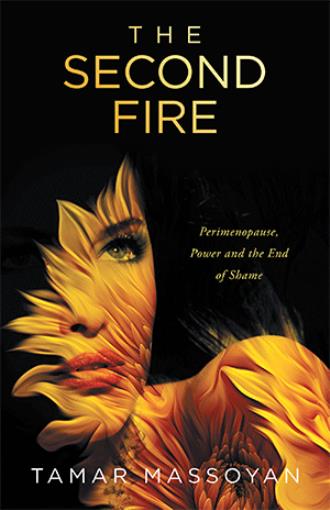
The Second Fire
Perimenopause, Power and the End of Shame
by
Book Cover & Preview Text
Chapter 4: Story Time — Conspiracies, Control, and the Women Who Wouldn't Stay Quiet “When a woman tells the truth, she is creating the possibility for more truth around her.” — Adrienne Rich I wasn’t always someone who questioned authority. In fact, for most of my life, I had a deep reverence for institutions. I followed the science. I trusted the system. I prided myself on being a realist — one of those people who rolled their eyes at conspiracy theorists, dismissed their warnings, and clung to the comfort of consensus. The idea that massive systems could be corrupt or manipulative? That felt absurd. Fringe. Dangerous. I wanted nothing to do with it. That all changed when I had children. Motherhood cracked something open in me — a fierce, primal knowing that couldn’t be reasoned away. Suddenly, the world didn’t feel so trustworthy. Suddenly, I was questioning everything I’d been taught. Was this medicine actually necessary? Was this intervention safe? Who was profiting from my choices — and my ignorance? Slowly but surely, the veil began to lift. This chapter is a blend — part personal journey, part medical history, part cultural call-out. Some of what you’ll read may sound like conspiracy. Some of it is fact. Some lies in the blurry in-between where truth has been manipulated, denied, or hidden. But all of it matters — because it helps us understand why perimenopause has become a minefield of confusion, shame, and silence. Let’s start by following the money — and the hormones. Big Pharma and the Hormone Deficiency Myth One of the most successful rebrands in medical history was the pathologizing of menopause. In the mid-20th century, pharmaceutical companies began marketing menopause not as a natural transition but as a “hormone deficiency disease.” The subtext was clear: without estrogen, a woman was no longer whole. No longer feminine. No longer herself. This wasn't just medical overreach — it was a marketing strategy. In the 1960s, hormone replacement therapy (HRT) was sold as a fountain of youth. Ads promised that estrogen would keep women slim, sexual, and sane. The messaging was seductive: take this pill, stay young forever. The truth? Not quite so glamorous. By the 1970s, links between estrogen-only HRT and endometrial cancer began to emerge. In the decades that followed, combination therapies (adding progestin) were introduced to mitigate those risks. But the risks never disappeared. In 2002, the Women’s Health Initiative revealed that combined HRT increased the risk of breast cancer, heart disease, stroke, and blood clots. Overnight, millions of women were thrown into panic — abandoned by a system that had once sold them safety. Today, HRT is more refined. Doses are lower, delivery methods more diverse. Bioidentical hormones are often touted as safer. But the fundamental question remains: Why were we ever told that menopause — a universal, natural transition — was a disease? Who benefits when women believe they’re broken? The Lack of Research Isn’t an Accident Less than 2% of global medical research funding goes to conditions specific to women — and only a fraction of that is devoted to perimenopause or menopause. Despite half the population going through this transition, most medical professionals receive little to no training on it. Doctors are often ill-equipped, dismissive, or quick to prescribe antidepressants instead of investigating hormonal shifts. This isn’t benign neglect. It’s systemic disinterest. Women’s health is only prioritized when it’s linked to reproduction — when it serves economic or political ends. Once fertility wanes, so does attention. Ask yourself: if men went through a years-long, biologically mandated hormonal transition marked by hot flashes, insomnia, and emotional upheaval — would we call it “normal” and ignore it? Or would there be an entire medical subspecialty devoted to making them comfortable? The Anti-Aging Industry Is Psychological Warfare We’ve been taught to fear aging not because it's painful — but because it makes us less profitable. Youth sells. Youth seduces. Youth keeps us buying creams, pills, injections, and procedures in a desperate attempt to stay “relevant.” The cultural silence around menopause isn’t just awkwardness — it’s economic strategy. Because when a woman stops bleeding, she often stops playing by the rules. She’s no longer birthing. She’s no longer compliant. She’s no longer consumed with being chosen. She becomes dangerous — because she becomes free. Many spiritual traditions saw the post-menopausal woman as a wise elder, a spiritual leader, a medicine woman. Our culture? It renders her invisible. But don’t be fooled — that invisibility is not natural. It’s manufactured. And the industries that benefit from our shame have a vested interest in keeping it that way. Hormonal Birth Control and the Partner You Didn’t Choose Here’s one that rattled me: hormonal birth control may change who you're attracted to. I’m not talking about mood swings or libido (though those matter too). I’m talking about something deeper — your mate selection instincts. In a natural cycle, during ovulation, women tend to prefer more genetically compatible partners with stronger masculine features. On the pill — which suppresses ovulation — those preferences shift. Studies suggest women may gravitate toward less masculine, more nurturing men, potentially at the expense of long-term biological compatibility. Some research backs this up. Some doesn’t. But it begs an important question: what happens when we alter something as primal as attraction? What do we lose when we chemically override our deepest instincts? It may sound fringe. But the implications aren’t. If the pill alters who we choose to love, marry, and procreate with, then it’s not just a lifestyle choice. It’s a sociocultural experiment — one we never fully consented to. Could this also be attributed to the rise in divorce rates? Puerto Rico: Birth Control Trials Without Consent Let’s go back to 1956. San Juan, Puerto Rico. American researchers are trialing what would become the first birth control pill. They choose Puerto Rican women — mostly poor, mostly uneducated — to test high-dose hormones. The women are not told they are part of an experiment. Many experience devastating side effects. At least three died. Their deaths are dismissed as unrelated. No one is held accountable. The reason Puerto Rico was chosen? No laws against birth control, a densely populated “territory” with little political recourse, and a population deemed expendable by the U.S. medical establishment. This is not conspiracy. This is documented history. And it should haunt us. India: Population Control Under the Guise of “Aid” Between the 1960s and 1990s, similar experiments occurred in India. With backing from U.S. organizations like USAID and the World Bank, injectable contraceptives were tested on impoverished rural women. Many couldn’t read. Few gave true informed consent. Some were coerced with promises of food or basic medical care. The side effects were severe — hemorrhaging, infertility, mental health issues. No real accountability followed. All of it done in the name of “development.” All of it done to “help” women. What these stories show is that control over women’s reproductive systems — whether through pills, injections, or silence — has never just been about health. It’s been about power. What This Has to Do With Perimenopause You might be wondering: what does all this have to do with me, sitting here in the fog of perimenopause, feeling like I’m coming undone? Everything. Perimenopause is the moment where the veil lifts. The hormones shift, the body rebels, and the soul says, “Enough.” The illusions fall away.
Select Format

Book Details
About the Book
What if perimenopause isn’t your downfall—but your divine activation? In The Second Fire, Tamar Massoyan exposes the truth behind a crisis affecting millions of women: the confusion, gaslighting, and spiritual disconnection surrounding perimenopause. Armed with rigorous research and raw personal testimony, she takes readers on a journey through hormonal chaos, medical betrayal, and the deep inner work that sparked her spiritual rebirth. Part memoir, part manifesto, part medical awakening, this book unpacks why Western women are suffering more than ever. Tamar follows the trail from processed foods and endocrine disruptors to synthetic hormones, birth-control culture, religious distortion, and patriarchal healthcare—all the forces that have muted women’s intuition and severed them from their God-given design. She doesn’t just reveal the villains. She hands you the torch to burn the script and write a new one. The Second Fire dismantles toxic myths about aging, calls out the profit-driven silence in women’s health, and invites every woman to reclaim her cycles, her body, and her spiritual authority. This is the rebellion wrapped in reverence—the revolution wrapped in faith. If you’re tired of being dismissed, medicated, or misunderstood… If you’ve felt the fire rising inside you and don’t know what to do with it… If you’re ready to rise with truth instead of shrink with shame… This book is your matchstick.
About the Author
Tamar Massoyan is a truth-seeking naturopath, life coach, and founder of Thrive with Tami, where she leads a rising movement of women ready to challenge the medical narratives that have failed them for decades. Driven by her own battle with perimenopause and the refusal to accept half-answers, she uncovers the systemic blind spots, cultural conditioning, and toxic trends that disconnect women from their bodies. Tamar’s work blends natural healing, spiritual wisdom, and radical honesty to help women reclaim their intuition, rewrite their stories, and ignite the fire within.