

Broken Ladder:
The Collapse of Entry-Level Jobs in a World Transformed by Autonomous AI Agents
by
Book Cover & Preview Text
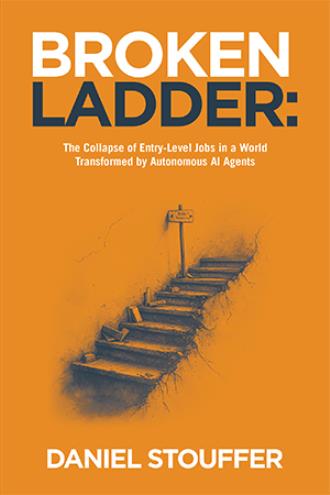
“The first rung of the career ladder is gone. If you’re still hiring as if it’s not a priority, you’re building on air.” I keep the book on the corner of my desk. The cover is worn now. Pages are creased and underlined. There’s a sticky note on the back that reads, in my hurried handwriting, “You didn’t just fix hiring. You rebuilt what work could become.” I must’ve written that in a moment of quiet clarity. I don’t remember exactly when. But I remember how I felt: like I had finally found language for the thing I’d been carrying. To be honest, I was tired. Not the kind of tired that goes away after a weekend off, but the more profound fatigue of holding together systems that no longer reflect how people live and work. I was tired of watching our early-career programs erode, as talent slipped through our fingers while we wrote new policies that no one believed in. I was tired of meetings where the same ideas were rewrapped and relabeled, but never reimagined. And I was tired of pretending we could continue to do more with less. That’s when I picked up this book. Reading Broken Ladder was like hearing someone speak the quiet part out loud. It put words to the dissonance I’d felt for years, the slow breakdown of entry-level roles, the assumptions we’d normalized, and the human cost of pretending that the old systems still worked. But more than that, it reminded me that we still have a choice. A Shift in Perspective This book didn’t just give me a framework. It gave me a mirror. A reminder that while we may not control the tides of technological change, we can still shape the shoreline. Through The LOOP Framework, I began to view my work in a new light. I started looking not just at who we hire, but how we hold them once they arrive. I started listening more closely, not for performance metrics, but for moments of belonging. I began asking: What signals are we sending? What kind of story does our onboarding tell? Are we designing for efficiency or humanity? The answers weren’t always easy. But they were honest. We didn’t scrap everything. That’s not realistic. Culture doesn’t change on command. But we started looping. We introduced pause points for reflection. We added shadowing to our internship program. We rewrote our feedback forms, actually to surface readiness, not just recall. And little by little, something shifted. Managers began to attend intern showcases. HRBPs asked more profound questions. Our interns stuck around, not out of obligation, but because they felt part of something. It Was Never Just About Filling Roles I’ve stopped seeing my work as transactional. I see it as translational now. My job is to translate potential into practice, possibility into design. That shift didn’t make everything easier. But it made it matter more. I find myself talking less in meetings, but saying more. I ask different questions. I stay curious longer. I speak up when we default to checklists instead of care. What this book gave me wasn’t a prescription. It was a pattern—a way to see the signal in the noise. And that, in a time like this, is no small gift. A Personal Moment of Truth A few weeks ago, my daughter asked me what I do at work. She’s 20. She’s smart, skeptical, and just starting to explore the job market. I told her, “I help build ladders.” Not the old kind. Not the climb-or-fail, pedigree-first, gatekeeping kind. The type that adjusts. The kind that meet people where they are and give them room to grow. She raised an eyebrow and said, “Do they work?” I paused. …Then I said yes. Not because they’re flawless. But because they’re designed with care. Because they offer space for someone to find their footing. Because they don’t assume readiness, they invest in it. Because someone finally decided to fix what was broken. And they did it with humility, with intention, and with enough courage to try. I’ve Learned to Believe Again There are still days when I doubt. A leader withdraws support; a pilot stalls. A well-intentioned initiative gets flattened by budget constraints. But then something happens. A peer asks if they can borrow our rubric. A former intern sends a note thanking us for making their growth visible. A senior leader, once skeptical, says, “This feels different. Keep going.” And I do. That’s the real lesson here. Not that transformation is linear or obvious. But we may listen if we loop. If we choose to build something instead of waiting for someone else to fix it. If You’re Still Reading You’re part of this. Maybe you’re further ahead. Perhaps you’re just beginning. Possibly you’re standing at the edge of that same exhaustion I once felt—the kind that makes you question whether the work is worth it, whether change is even possible. But here’s what I’ve learned: Exhaustion doesn’t mean you’re broken. It means you’ve been holding too much without a system that holds you back. And that’s where this book comes in. If you’re reading this, you’re already doing the work. You’ve taken the first step toward reimagining what’s possible, not just for your team or your company, but for the people who haven’t yet walked through your doors. You’re someone who chooses to see the cracks not as failures, but as invitations. Invitations to reframe, to rebuild, to lead differently. This book gave me courage. It gave me language. It gave me tools. But most importantly, it gave me company. It reminded me that I’m not alone in believing that early-career systems can be beautiful again. And now it sits within arm’s reach on my desk, dog-eared, lived-in, ready to be passed along to someone else who’s prepared to believe too. Not a finish line. A beginning…
Select Format

Book Details
About the Book
Autonomous AI agents are replacing entry-level roles at scale, silently, efficiently, and without remorse. What once offered learning, belonging, and forward motion is now a closed door. And while talent pipelines run dry, leaders are left clinging to outdated systems that no longer attract top talent.
Broken Ladder is a call to rebuild the beginning. Not as an afterthought. As a design imperative. If you are responsible for hiring, onboarding, or developing tomorrow’s workforce, this book speaks directly to you.
Daniel Stouffer, a systems strategist and trusted futurist, offers both an accurate diagnosis and a profoundly human solution: stop pretending the old model works. Replace it with something that does.
Inside, you’ll learn how to:
• Uncover the silent failures hidden inside your hiring practices
• Build hybrid AI-human systems that develop capability, not just compliance.
• Create access for those whose pedigree-driven pipelines have never served.
• Redesign work from the first step, not the last title
• Lead transformation that’s actionable, inclusive, and built to last.
You don’t need another playbook for jobs that no longer exist. You need a blueprint for building what’s next. Broken Ladder is this book.
About the Author
Daniel Stouffer is a workplace futurist and systems thinker who helps organizations reimagine how they grow talent. He writes for leaders ready to move from reactive HR to cultural redesign. With empathy, foresight, and practical tools, Daniel shows how to turn broken hiring systems into launchpads for hybrid talent.