

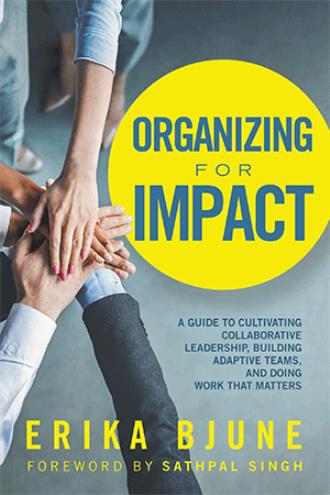
Organizing for Impact
A Guide to Cultivating Collaborative Leadership, Building Adaptive Teams, and Doing Work That Matters
by
Book Cover & Preview Text
From "Power Over" to "Power With" For a long time, hierarchical structures have been the de facto standard for organizing work. Dating back to the late 19th century, managerial hierarchies are rooted in principles of "power over" relationships—those at the top make decisions and direct those below them. This "command-and-control" style has been effective for stability, efficiency, and predictability. However, when environments are uncertain or rapidly changing, as they are today, hierarchies reveal their limitations, stifling innovation and creating a disconnect between the people making decisions and those affected by them. Managerial hierarchy relies on two basic principles: a hierarchy of authority, in which managers have the authority to prioritize and direct individuals' tasks, review their performance, and hire and fire them, and a hierarchy of accountability, in which work accountabilities roll up the ladder, from direct reports to managers who are responsible for the outcomes of those below them.2 Front-line employees are responsible to their managers, who are responsible to their managers, and so on up the chain. In essence, this structure fosters a "power over" dynamic. Those at the top are accountable, while those lower in the hierarchy shoulder the responsibility and have little power to influence decisions or challenge directives. As a result, they are often reduced to being cogs in the machine, following orders with little space for their creativity, innovation, or autonomy. Subordinates generally must accommodate whatever is handed down from above or risk being disciplined or fired. Ironically, people entering large hierarchical organizations expect this dynamic and expect to have to prove themselves to climb the hierarchy ladder. For many people, this climb requires so much time and effort that the mission of the business itself takes a back seat to this collective drive to outshine each other. I call this corporate conditioning and the longer someone works in such an environment, the stronger this conditioning becomes, making it easy for hierarchies to reproduce and spread. This hierarchical, "Orange" way of thinking, which focuses on predictability, efficiency, and profits, serves a purpose in stable environments where the pathway to success is clear and does not require continuous adaptation. However, these structures often become oppressive when more complex, uncertain, and interconnected challenges arise–ones that require fast feedback, creativity, and cross-functional collaboration. Hierarchies concentrate power and responsibility among a few people, which creates bottlenecks for decision-making, makes it difficult to respond quickly to change, and can disengage and demoralize the people doing the work. These structures ultimately lead to inequities in how power, bonuses, and opportunities are distributed. People higher up the ladder are often retained under performance contracts that provide more privileges and bonuses than their subordinates get (if they get anything at all). It is yet another mechanism that encourages a hard-line separation between those with power and those with none. They are not going to share their bonuses but rather will protect them to the detriment of those who report to them. The company is losing money, and my bonus is at risk? Well, let me fire a few people to bring the budget back into balance and protect my piece of the pie. Individuals may also be held back by biases, politics, or sheer happenstance, reinforcing privilege and discrimination. Even in more progressive organizations, the power dynamics inherent in a hierarchy create informal barriers to sharing leadership, which perpetuate the status quo. Despite the veneer of inclusivity, companies with these dynamics often develop a culture where voices from traditionally marginalized groups may still find it challenging to be heard or valued to the same extent as their counterparts. This dynamic doubles down on the fact that managerial hierarchies create status and privilege differences, which in turn can stifle or outright block the ability of people to grow and develop their careers and themselves. This is not to say that hierarchies are inherently "bad." They are merely reflections of the levels of organizational consciousness at which different organizations can choose to operate. This kind of structure creates a form of simple efficiency when it comes to goal setting and resolving disagreements, and it establishes clear accountability and control. These are factors that work best when conditions are stable and the trajectory of work is known and predictable. Because directives flow from top to bottom, the structure is more rigid and works well for executing plans that are not expected to change much, if at all, along the way. This is how the typical Orange organization is structured. Hierarchies are also deeply ingrained in the way businesses think they need to operate to make profits for shareholders. They are about having a sense of control, and the temptation to use them is almost instinctual. It doesn’t mean that such power is inherently abusive because managers usually have the ability to choose what they do with their power. Someone up the food chain can decide to support and mentor you, but they can just as easily put obstacles in front of you and ultimately fire you so that they can meet accountabilities that you are responsible for but have no say in. Teal organizations, however, offer a different path–one that emphasizes self-management as a way to move beyond traditional power dynamics by distributing power, increasing inclusivity, and fostering agility. In self-managing organizations, traditional hierarchies are replaced by structures that empower individuals and teams to make decisions collaboratively and autonomously. "Teal organizations have found the key to operate effectively, even at a large scale," explains Laloux, "with a system based on peer relationships, without the need for either hierarchy or consensus." Self-management means pushing decision-making down to where the information is, creating clarity of roles and expectations, and using structured processes to ensure accountability–all without the need for traditional managerial oversight. A great way to imagine this is to compare self-managed organizations to a traffic circle, aka a roundabout. In a typical intersection with traffic signals, rules dictate when you can move, often causing delays as everyone waits their turn. But in a roundabout, there is flow; each driver pays attention to the others, adjusting their speed and movement fluidly to keep traffic moving. Everyone is equally empowered to make decisions that maintain both their forward momentum and the flow of traffic as a whole. Self-managed organizations work similarly. "When it comes to how [self-managing organizations] build teams, manage projects, make decisions, share information, set targets, review performance, and set compensation, their approach is not a signal-controlled intersection but a roundabout," offers Aaron Dignan in Brave New Work. Instead of strict, hierarchical rules and bottlenecks, they create fluid and responsive systems built on trust, shared purpose, and clear agreements. By fully sharing power, organizations open the door to increased innovation, adaptability, and resilience. Teams are given the freedom to make decisions quickly and independently, which allows them to respond to emerging challenges in real time and build trust through transparency and accountability. Thus, instead of maintaining power over each other, colleagues in a self-managed organization share power with each other. To move from a “power over” to a “power with” approach means redefining power as shared, collaborative, and grounded in partnership rather than control.
Select Format

Book Details
About the Book
What if leadership wasn’t about control but about unlocking the full potential of people and teams? Organizing for Impact is a call to action for leaders, changemakers, and organizations ready to move beyond outdated hierarchies and embrace a more adaptive, people-centered way of working.
Rooted in the realities of complex, ever-evolving organizations, this book explores what it truly takes to build a resilient, high-impact workplace—one that balances structure with adaptability, aligns action with purpose, and fosters a culture where leadership is shared, autonomy is real, and collaboration is built on trust, not control.
Through the IMPACT model, you will discover a roadmap for building organizations that empower their members, foster high performance and deep engagement, and create the conditions for meaningful, lasting impact. This model helps organizations replace outdated structures with operating systems that support agility, shared leadership, and purpose-driven action.
This book goes beyond theory, offering practical tools and real-world strategies to bring these ideas to life and drive transformative change. It is an invitation to join a movement to reimagine leadership and build a future of work that truly works for people.
About the Author
Erika Bjune is a transformative leader, executive coach, and organizational strategist with a passion for reshaping the way we work. With decades of experience at the intersection of technology, leadership, and self-management, she has guided teams and organizations through groundbreaking shifts toward more adaptive, people-positive ways of working. As the founder of Transformetic, Erika helps leaders and organizations move beyond outdated hierarchical structures to cultivate adaptive, purpose-driven teams and organizations. Through her writing, coaching, and consulting, Erika brings a unique, engaging voice—one that blends deep expertise with a conversational, no-nonsense approach. She believes in making complex ideas accessible, practical, and actionable, helping readers not just understand transformation but live it.