

Moloo Musalli
In Search of Lost Humanity
by
Book Cover & Preview Text
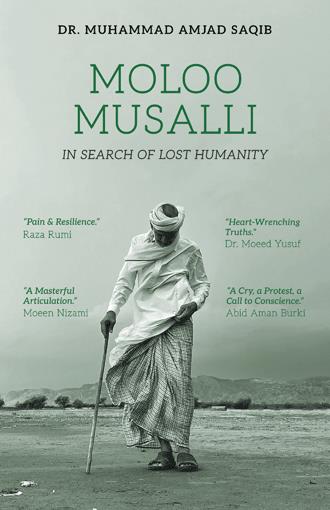
Moloo Musalli This tale is woven with the threads of Moloo Musalli's life — his days and nights, his struggles and sorrows. A long time ago, a few police officers sought to search an old house. They were met with a stern retort: "Beware! This is the house of the Chaudhrys, not of any Moloo Musalli." At this, the officers folded their hands, begged forgiveness, and retreated with the words, "Had we known it belonged to the Chaudhrys, we would not have dared. Had it been Moloo Musalli's house, we would have stormed in without any fear and hesitation." Who is this unfortunate soul, Moloo Musalli, whose name drips with disdain? What separates his house from that of the Chaudhrys? Who are his mother and sisters? Are they any less human than those of the Chaudhrys? Why can the police barge into his home with impunity, but hesitate before knocking on a Chaudhry's door? This dismissive tone, left unquestioned, embodies a profound tragedy — an unspoken indictment of our societal and economic systems, of the deeply entrenched inequalities that stain our collective conscience. These words are not just a piece of news but a tragedy that lays bare the full picture of our political, economic, and social system. This story reflects the centuries-old oppression that has become the destiny of millions of Moloo Musallis today. The Chaudhry and Moloo Musalli are not merely individuals or families; they symbolize two starkly contrasting realities. The Chaudhry represents the privileged elite, while Moloo stands for the countless souls crushed beneath the wheels of oppression — by Chaudhrys, landlords, Maliks, Khans and tribal lords. Moloo Musalli's existence is a perpetual crucifixion on the cross of injustice. His story is a searing indictment of humanity's collective conscience, and a damning charge against humanity itself. Even a mention of Moloo Musalli brings scorn upon him, as does the mere existence of his mother and sister. These daughters of Eve hold a status lower than the dust in the alleys. They are viewed not as beings with dignity but as objects — clay toys or lifeless lumps of flesh. These unfortunate women toil in fields, homes, and factories, sowing seeds of life everywhere, yet their own lives are desecrated by the hands of powerful. Their childhoods, youth, and old age are never truly their own. Moloo Musalli's son fares no better. His destiny is etched in stone: to grow up only to become another Moloo Musalli. He is like an ox yoked to a millstone, forever circling but never breaking free. Once, a son of a Moloo Musalli asked his mother, "Amma, if the village Chaudhry dies, who will become the new Chaudhry?" "His son," she replied. "And if he dies?" "Then his son." "And if he dies too?" "Then his son," she sighed, wearied by the child's questions. Finally, she said with despair, "My son, the whole village could perish, but you will never become a Chaudhry." The cries of Moloo Musalli echo with unspeakable pain — a lamentation of humanity itself. Moloo, his mother, his sisters, and his children are a forsaken race with no one to advocate for them. Neither the police station, nor the courthouse, nor the parliament offer them solace. The earth denies them refuge, and the heavens refuse them shade. Their lives are stitched with patches of deprivation — no bread, no shelter, no dignity. In this world teeming with champions of democracy and equality, Moloo Musalli stands with his head bowed, like a criminal among kings. He hears talk of schools, hospitals, roads, clean water — but none of it matters to him. He asks but one question: "When will I have dignity?"
Select Format

Book Details
About the Book
Like Pakistan in every forgotten corner of the world, there are faces that the light no longer seeks. Moloo Musalli: In Search of Lost Humanity gathers those faces and listens to their silence. These are the stories of the unseen — widows who still wait, orphans who still hope, transgenders who still smile, labourers who still dream, and souls who have found grace even in despair.
Moloo Musalli is not a name — it is a metaphor for the abandoned human spirit, for all those who stand at the edge of society and yet carry its deepest truths. Each story is an act of remembrance, a whisper that humanity, though lost, still breathes within the dust. It is a book of empathy, faith, reflection and hope — a call to rediscover the sacred bond that binds us to one another.
These pages ask a simple question: how poor is a nation that forgets its poorest?
About the Author
Dr. Saqib is a social entrepreneur and former civil servant who left service to dedicate his life to Akhuwat, an organization he founded in 2001. Built on the principles of solidarity and brotherhood, Akhuwat has disbursed USD 1.7 billion as interest-free loans, supporting over four million families across Pakistan, and has established the country's first fee-free university for talented students.
His work has earned global recognition, including the Ramon Magsaysay Award (2021), commonly known as the Asian Nobel Prize, and the Commonwealth Point of Light Award by Queen Elizabeth II. He has received Pakistan's coveted civil honors, including the Sitara-e-Imtiaz and Hilal-e-Imtiaz. An author and sought-after speaker, he has addressed institutions such as the United Nations, Harvard, Oxford, and Cambridge.
Dr. Saqib's journey reflects a deliberate choice to stand with the poor, challenge powerlessness, and build institutions rooted in dignity and lasting change.