

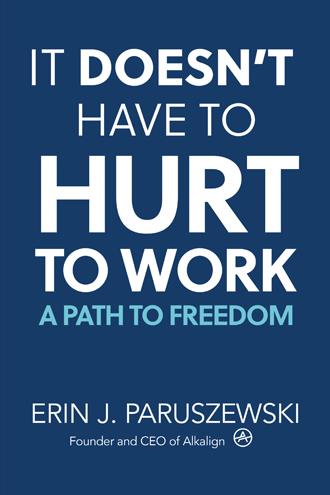
It Doesn't Have to Hurt to Work
A Path to Freedom
by
Book Cover & Preview Text
Let’s pause for a quick moment and talk about what it means to trust your gut. I don’t just want to keep throwing that phrase around without giving it some kind of definition. We often talk about “trusting your gut” or “using your brain.” But saying it that way makes it sound binary—like one is better than the other, like it’s either/or. But it’s a both/and statement because your gut is essentially your second brain. According to Stanford microbiologists Drs. Justin and Erica Sonnenburg, a primal connection exists between the gut and the brain. As they explain in their book, The Good Gut: “Our brain and gut are connected by an extensive network of neurons and a highway of chemicals and hormones that constantly provide feedback about how hungry we are, whether or not we’re experiencing stress, or if we’ve ingested a disease-causing microbe. This information superhighway is called the brain–gut axis, and it provides constant updates on the state of affairs at your two ends.”4 Thus, listening to and trusting your gut is of the utmost importance. It’s the same thing as using your brain. Finding My Way to Functional I opened my first barre studio in Menlo Park in March 2009, and a few months later, in January 2010, we opened one in the neighboring town of Los Altos. Barre workouts consisted of exercises inspired by ballet. Thus it was a natural fit for me to be a barre instructor, and now a barre studio owner, with my background in dance. I was fulfilling my childhood dream of ballet-like movement everyday, even if it wasn’t in pointe shoes with a pink tutu. Barre workouts combined ballet with yoga and pilates exercises, which were in stark contrast to my super-speedy and sweaty cardio sessions but surprisingly effective. I especially craved the slower pace and opportunity to continue exercising without the excessive impact while I was pregnant. I gave birth to my oldest daughter, Ava, two months after we opened the second studio. In more ways than one, my path to a functional approach to life happened by chance, not by choice. It wasn’t something I was looking for, but it was something that had to happen. I couldn’t spend any more time living in a dysfunctional body. Even though I had reduced the amount I was running by the time I became a group fitness instructor, classes didn’t necessarily feel like “enough.” Old habits are hard to break, and I just couldn’t stop, even when I knew I needed to. Looking back now, I can see what a gift it was to find out I was pregnant in the middle of launching two barre studios. It felt like the “accidental circumstance” I needed in order to come up with an alternative to running. I also got really serious about my nutrition during that time, inspired by the tiny human I was incubating. My focus completely shifted from how food choices made me look on the outside to how food choices impacted the baby on the inside. Like so many of us who give birth to tiny humans or new dreams and ideas, I learned and evolved so much in the years after Ava was born. Not only did I want to figure out my gut issues for myself, but I also wanted to fuel my family in the best way possible versus slipping back into what was familiar. I had come a long way in my understanding of the human body and the acceptance of my own body. I knew being skinny was not synonymous with being healthy. In fact, there were, and still are, plenty of skinny people in my life struggling with diseases of the body, such as cancer, and diseases of the brain, such as eating disorders, stress, anxiety, ADHD, and a whole host of other issues. Those issues might have contributed to weight loss, but they come with a plethora of other problems, too. It hit me that in the absence of a strong body and balanced mind, skinny can look pretty scary. So I no longer strived to be skinny because I wanted to be physically and mentally healthy and strong. Despite these significant shifts in lifestyle and massive leaps forward in mindset, I was still caught off guard by unstable gut health that would upend everything. On one vacation, I ordered a salad without croutons. When the salad arrived with croutons, I simply removed them rather than sending it back. I spent the next 18 hours in pain on the couch in the fetal position with a toddler running circles around me. Frustrated, I went back to the drawing board and endured a whole litany of tests and procedures, this time 20 years after my first round of tests and on the opposite coast. Again, not one doctor asked about my nutrition, even in sprout-eating, avocado-consuming California. I decided to take charge and search for real answers. I did a few more tests to rule out Celiac disease. Thankfully, neither the endoscopy nor the colonoscopy results showed I had the disease despite having the gene. But my sensitivities to dairy and gluten were confirmed with continued trial and error. A bad hip, two fitness studios, an energetic toddler, an unsettled stomach, less time to run, and a lot of fear were the perfect storm for a lot of stress, which only made my health issues worse. It was also the storm that paved the path for me to find my way to better fitness and nutrition and, overall, a functional approach to life. And it all started when I found functional fitness.
Select Format

Book Details
About the Book
It Doesn’t Have to Hurt to Work is a transformational memoir about breaking free from the physical pain and mental misery of achieving the “perfect” body, and a guide to helping you find strength and whole-body health through the practice of functional fitness. As a former cardio-junkie and champion calorie-counter, author Erin Paruszewski grew up believing that “more is more” when it came to exercise and “less is more” when it came to food. On the outside, she was in great shape. But on the inside, her body was falling apart thanks to the wear and tear of overexercising and fueling herself with a chemically processed, low-fat, high-sugar diet. After hitting rock-bottom, this reality set her on a new trajectory in both body and mindset. Erin’s lived experience and functional lifestyle pivot are the inspiration behind this how-to message as she blends narrative stories and research-based explanations of how our bodies and minds work best.