

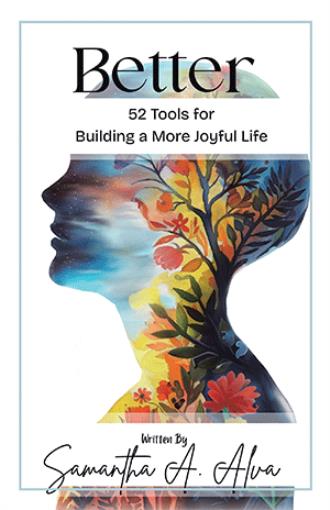
Better
52 Tools for a More Joyful Life
by
Book Cover & Preview Text
This book began as a survival kit for me. I was a caregiver, a student, a mom, a partner — pulled in many directions at once. Life felt heavy, and joy sometimes felt like something reserved for other people. But slowly, through research, therapy, education, and the little experiments I tried in my own life, I began to collect small, repeatable practices that helped me breathe again. These tools weren’t glamorous. They weren’t magic. But they worked — one tiny spark at a time. Better is a gathering of those sparks. Each tool is rooted in research from psychology, counseling, and trauma-informed care — but written in a way that feels human, playful, and real. This is not a book you have to read cover to cover. Think of it as a joy toolkit. Open it anywhere. Try one practice. Return later for another. Some you’ll keep forever; some you’ll outgrow and some you’ll grow into. That’s okay. Healing, self-care and growth aren’t linear, and neither is this book. These tools aren’t just for you, either. Share them. Try them with a child at bedtime, around the dinner table, in your journal, or with a friend who’s having a hard day. I’ve seen how quickly even the smallest practice can ripple outward and soften the edges of a moment. If you’d like more — printable versions of the tools, video walkthroughs, seasonal extras — you’ll find them at TheJoyfulSelfProject.com. That’s where I’ll continue adding resources and expanding on these practices, so this book can keep growing with you. However you choose to use it, my hope is that Better becomes a companion. Not another “should” on your shelf, but a reminder that you’re not broken — you’re becoming. And even in the middle of the mess, joy is still possible. How to Use This Book This isn’t a book you need to read in order. Think of it like a toolbox, a deck of cards, or a recipe book. Open it anywhere, try one practice, and see what fits. • Jump around. Each tool stands on its own. Start where you’re curious, or where life feels tender today. • Make it yours. Some tools may feel like keepers. Others won’t land right now — and that’s okay. Circle back later or skip ahead. • Use it solo or together. These practices can support you personally, but many are designed to be shared — with kids, partners, friends, therapy groups, or faith communities. • Keep it light. This isn’t homework. It’s an invitation to experiment. Even trying one tool imperfectly still counts. • Come back often. Growth isn’t linear. The same tool might meet you differently next month, or next year. • Go deeper. Printable worksheets, bonus tools, and seasonal extras are available at TheJoyfulSelfProject.com. Most of all — treat this book like a companion, not a demand. Let it meet you where you are and remind you that joy is something we can practice, even in small ways. SECTION I: Mood, Mind, and Meaning Grounding tools for emotional regulation and inner connection (CBT, DBT, ACT, TBRI-aligned) 1. Gratitude with a Twist Gratitude… Even Just 1% Gratitude isn’t about pretending everything is fine or covering pain with a smiley sticker. It’s about gently training the brain to notice any spark of meaning — even when life feels like ash. Research shows that even modest gratitude practices can improve mood, resilience, and relationships over time. And when gratitude is paired with emotional acceptance, it becomes a form of integration — not denial (Kiken, Yates, & Froh, 2025). Imagine a jar painted black, and the paint is cracking, there is one firefly inside. The gratitude is the light shining through the cracks. Even a little glow matters. When to Reach for This Tool • When Gratitude feels impossible. • When You’re stuck in resentment, grief, or numbness. • When Caregiving, burnout, or loss has worn you down. • When Joy feels far away but you want to stay soft to life. This practice is especially helpful for those who lean into black-and-white thinking. It makes space for the gray zone: “I hate this part… and also… I see a sparkle in this part.” How to Practice “1% Gratitude” 1. Pick a moment in your day — bedtime, after coffee, in the shower. 2. Instead of searching for something “big,” whisper a tiny truth. • “Part of me — maybe just 1% — is grateful for __________.” • “Even though I feel __________, I can also notice __________.” 3. Use whatever form works: jot in a notebook, doodle, record a voice note, or offer a quiet prayer. 4. On the hardest days, gratitude may simply be for your own breath or for the strength it takes to keep showing up. Let it be messy. Let it be real. Try This Prompt Fill in the blanks each night for a week: “Even though today felt __________, I can still notice __________.” Optional variations: “I feel __________, and also __________.” Keep your answers small and true — a cup of tea, a text from a friend, the way the air felt when you opened the door. Barriers You Might Notice “I can’t think of anything.” → Then be grateful for your honesty, or for the courage to even try. “It feels fake.” → Remember, this isn’t toxic positivity. It’s about our human complexity. Even 1% counts. When using it with: Kids: Invite them to draw something that felt both good and bad, and talk about both sides. Couples: Share one tiny gratitude at bedtime — “Thanks for refilling the coffee” counts. Faith: Offer your suffering as sacred. You don’t have to be grateful for it, just grateful in it. "Even in the middle of the mess, there’s still something I can notice with thanks."
Select Format

Book Details
About the Book
Better: 52 Tools for a More Joyful Life is a practical, compassionate guide for anyone seeking steadiness, healing, and meaning in the midst of life’s chaos. Drawing on evidence-based practices from CBT, DBT, ACT, TBRI, narrative therapy, and mindfulness, this book offers simple, imaginative exercises that help you move from surviving to thriving—one small step at a time. Instead of overwhelming theory, each of the 52 tools is written as an accessible practice you can try in the real world—whether you have five minutes in the morning, a quiet evening, or a moment between caregiving tasks. With a balance of psychology, creativity, and warmth, Better helps you to regulate emotions and find inner calm, repair relationships and strengthen connection, reclaim identity, resilience, and empowerment, ground yourself in body and spirit, rediscover wonder, meaning, and joy, and integrate growth into everyday life without pressure. Better isn’t about becoming perfect—it’s about becoming more present, more connected, and more whole. Whether you’re navigating stress, grief, transitions, or the weight of daily life, this book will meet you where you are and gently walk with you toward something brighter, steadier, and more joyful.
About the Author
Samantha Alva is a writer, parent, caregiver, and therapist-in-training. She has spent her life weaving together experience, science, and heart. She holds a master’s degree in psychology with an emphasis in health, and has a second master’s in progress in mental health counseling. She brings both academic knowledge and lived experience to her work. Her journey has included growing up with a mother with mental health challenges, raising children with complex needs, caring for her father as he ages. She navigates her own stresses gracefully, along side loss, and every day life. Her experiences shaped her belief that joy is not something we stumble upon — it’s something we choose, and practice, one small shift at a time. Samantha is the founder of The Joyful Self Project, where she shares resources, workshops, and community to help people build joy, steadiness, self-compassion, and connection in everyday life. She also speaks and writes on resilience, trauma-informed care, and the simple practices that make joy possible even in hard seasons.