

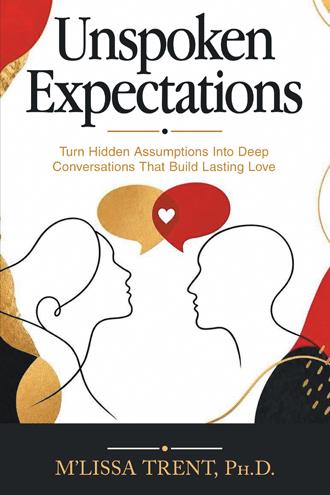
Unspoken Expectations
Turn Hidden Assumptions Into Deep Conversations That Build Lasting Love
by
Book Cover & Preview Text
Each of us carries an internal story, about what love, and partnership should look like and feel like. We form that story over time through lived experiences, early caregivers, past relationships, culture, religion, media, and our deepest longings. Much of it remains unspoken. We may not fully name these expectations even to ourselves, much less to the person we love. (The entire into but wouldn’t let me put it here) When expectations stay hidden, they do not disappear. They tend to surface instead as disappointment, resentment, confusion, and a gradual erosion of trust. What one partner experiences as obvious, reasonable, or loving may feel surprising, unfair or even hurtful to the other. The problem is often not a lack of love, but a lack of clarity about internal assumptions. Romantic partnerships shape our sense of belonging and well-being in profound ways. Yet few of us spend meaningful time clarifying what we truly need and expect before entering a long-term partnership. We prepare for careers, education, sports, hobbies, and financial goals, but we are rarely taught how to build emotional literacy, communicate relational needs, or practice love with maturity and skill. Our culture celebrates mastery in almost every domain except the one that may matter most: how to love and be loved well. Many people enter serious relationships without ever asking themselves basic but life-shaping questions: What does commitment mean to me? What helps me feel safe? What do I assume love should look like? What expectations am I carrying that I have never put into words? Modern relationships ask much more of us than they once did. Historically, marriage was often tied to survival, social stability, financial security, and child-rearing. Today, many people still want those forms of support, but they also want passion, friendship, emotional safety, shared meaning, healing, growth, and self-expression. As Eli Finkel writes in in The All-or-Nothing Marriage, “In contrast to our predecessors, who looked to marriage to help them survive, we look to our marriage to meet our needs for passion and intimacy, and to facilitate our voyages of self-discovery and personal growth” (Finkel 2017, 13). At the same time, we are surrounded by idealized images of love. Film, television, social media, and fantasy can quietly shape our expectations, teaching us to confuse chemistry with compatibility and intensity with emotional safety. Without realizing it, we may project our hopes onto a partner and assume they should simply know what we need without our having to say it. But lasting love is not built through mind reading. It is built through self-awareness, honest conversation, mutual curiosity, and explicit agreements. Our early experiences also shape our expectations deeply. Many of us learned what love looks like by watching caregivers, absorbing family rules, and adapting to what felt normal in our homes. Sometimes those models were nurturing. Sometimes they were painful, inconsistent, controlling, or emotionally limited. As adults, we may feel drawn toward what is familiar even when it is not healthy. We may confuse chemistry with compatibility, intensity with safety, or longing with love. The demands placed on modern relationships are real, and they can feel overwhelming when couples are under stress or lack good models. Thriving together requires emotional maturity, conscious effort, and a shared commitment to fairness and mutual care. As Stan Tatkin writes in In Each Other’s Care (2023, p.5), secure functioning is a relational agreement between two individuals of equal power and authority “to remain fair, just, and sensitive at all times, while also remaining fully collaborative and cooperative.” This means shifting from a one-person psychology (“What do I need?”) to a two-person psychology (“How do we protect our relationship and support each other?”). When we are infatuated early on in relationship, flooded with dopamine and serotonin, it can be easy to overlook this foundation. The excitement of new love can make us impulsive and less grounded, and we may ignore red flags or gloss over important differences in the name of chemistry. No partner can meet every need, and no relationship can carry the full weight of a human life. Mature love does not deny this truth; it works with it. It allows for intimacy without fusion, support without overdependence, and devotion without the loss of self. In that sense, this book is an invitation into interdependence: a way of loving that honors both connection and individuality. As relationship educator Chindah Chindah writes in What Can I Do to Make My Marriage Work? (2017) “The more realistic our expectations and the clearer our agreements, the more satisfaction we are likely to experience in our relationships.” The goal of this book is not to strip love of its mystery and beauty. It is to give love a solid place to land. The chapters that follow invite you to examine the expectations you have inherited, the agreements you have left unspoken, and the patterns you may be repeating without realizing it. They are meant to help you bring more clarity, honesty, and intention into the way you love. While this book sometimes draws on research that reflects heterosexual couples, the principles, questions, and conversations offered here apply equally to partners of all genders and orientations. Love, commitment, and the work of partnership are not defined by who we love, but by how we show up for one another. Whether you are single, dating, newly partnered, or in a long-term relationship, the work here is not about becoming perfect. It is about becoming conscious. It is about choosing relationships with open eyes, naming what matters, and learning how to build connection that is resilient enough to grow with reality rather than collapse under fantasy.
Select Format

Book Details
About the Book
UNSPOKEN EXPECTATIONS Turn Hidden Assumptions into Deep Conversations That Build Lasting Love M’Lissa Trent, Ph.D. Every person enters a relationship with an unspoken blueprint of what they feel love should be, yet we often expect our partners to read our minds. As Anne Lamott wisely said, “Unspoken expectations are resentments under construction.” In Unspoken Expectations, Dr. M’Lissa Trent provides the tools you need to dismantle those hidden assumptions before they jeopardize your connection. Drawing on insights from renowned experts like John Gottman, Brene Brown, Stan Tatkin, and Esther Perel, this groundbreaking book navigates the critical topics couples often shy away from— love, commitment, gender roles, finances, intimacy, and family dynamics. Dr. Trent empowers you to transform vague hopes into clear agreements, fostering deeper understanding and connection. Each chapter combines sharp psychological insights with practical exercises designed to help you articulate your unspoken thoughts, feelings, and expectations. Whether you are single, newly partnered, or looking to recalibrate a long-term marriage, Unspoken Expectations offers the questions and courage you need to ditch the guessing game and build a love grounded in honesty and trust.
About the Author
M’Lissa Trent, Ph.D. is a licensed clinical psychologist and relationship educator dedicated to helping couples turn love into a sustainable, shared practice. Don’t wait—unlock the love you’ve always dreamed of and start your journey today!