

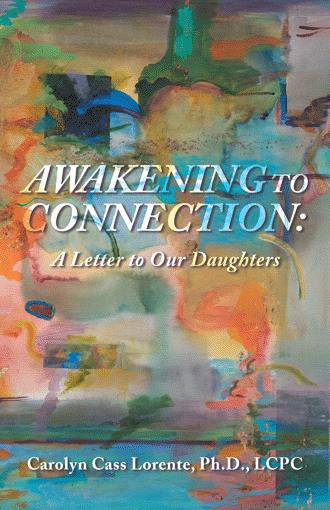
Awakening to Connection:
A Letter to Our Daughters
by
Book Cover & Preview Text
Chapter 3: “Do the Ones” : Growing and Thriving in the face of uncertainty From: Awakening to Connection: A Letter to Our Daughters Carolyn Cass Lorente, Ph.D. Don’t give into cynicism or despair. Cynicism breeds inaction. It is easy to be overwhelmed by all the changes going on around us. We often feel overwhelmed. Particularly in the 24/7, around-the-clock information deluge. Some people go to free floating anxiety while others “turtle” - shutting down, going into oneself, experiencing a generalized, low-grade depression. In both cases, the feeling is of detachment, dissociation, and seemingly without a cure. As a result, some keep themselves busy. They fill their lives with tasks that aren’t meaningful or purposeful, but help to keep the mind from truly feeling disappointment and despair, or worse, detached from hope. Others may retreat, staying in bed, wearing pj’s or sweats, “bed rotting,” watching hours of mindless programming, once again, with the same purpose of keeping the mind from truly feeling. When we feel that we have no power to change the things that truly matter to us we go into what is known as learned helplessness. The idea is that if we think we can’t change our situations we don’t even try. See Martin Seligman’s work on the idea of learned helplessness for this.1 In my early work with teenagers marginalized based on issues such as racism, sexism, poverty, immigration status, who they loved and how they loved, etc., many of these young people told me that they felt they had no chance of changing their situations. And they were right to feel that there were barriers to thriving that were so institutionalized that positive change was difficult at best. One of the great psychologists of our time was Urie Bronfenbrenner.2 He saw that one of the main issues with the study, diagnosis, and treatment of psychological disorders was that they took into account the individual, but did not take into account that the individual doesn’t exist in a vacuum. His approach offers the recognition that the individual is nested in a series of systems that influence each other in a bi-directional fashion. His theory embodies the popular line, “before you diagnose yourself as crazy make sure you are not just surrounded by assholes!” This idea that we are not only affected by our surroundings and environments, but that we also have the power to affect those environments is quite an important concept. The “power of one” can be both empowering and frightening. However, if you have experienced marginalization for a good deal of your life or feel that there are too many things that are wrong with the world and are impossible to change, you might shut down too. When thinking about this idea of agency, that is, control and responsibility over the quality of your life and your shared lives such as family, community, even the world, focusing on one small change at a time can be useful. This is particularly true if you are feeling stuck or feeling that you have no choice in your life circumstances. There is growing evidence that one small change toward a goal leads to more small changes.3 This is what psychologists call a positive, transformative experience. This “activation theory” is about flexing your bravery. As I like to say, “we become by doing.” When you don’t know what to do, just do the next best thing for you at that moment. So just “do the ones.” The “ones” on your list, not the “twos,” and definitely not the “threes.” These will be different for each person. I often have my clients write in the notes section of their phones their own “ones,” “twos,” and “threes” as reminders for when it’s too hard to think. For instance, the “threes” are things that are directly tied to your big goals and that take a lot of focus and energy to complete. They may require summoning others to assist. This can include writing a term paper, cleaning out the garage, or as it is for one of my clients, making doctor’s appointments. The “twos” are things that take energy, but aren’t too overwhelming. These are daily “do’s” such as putting in a load of laundry, doing tasks required at work, caring for our loved ones or ourselves. The “ones,” well, the “ones” are the most basic of tasks. Now if you are in charge of caring for others, or it’s a work day, your “ones” may be you just doing the very minimal effort in order to do what you are required to do. When we are under-resourced it counts to put our feet on the floor, make a slice of toast, drink a glass of water, breathe. Tomorrow will be another day. And when we honor the feeling, instead of pushing through, shaming, guilting, or berating ourselves, we often find that we have a little bit more strength to possibly take on a “two.” And if we band with others who are vibing with a little bit more resources, we can even tackle the “threes” together. But for now, just for now, for today, just “do the ones”*.
Select Format

Book Details
About the Book
Are you overwhelmed, depleted, exhausted? Instead of having hope for the future, are you feeling crushing despair and disconnection? Do you wonder how you have so many “friends” and “followers,” yet still feel lonely and detached? You are not alone. Many people in their late teens, 20s,, and later are feeling disconnected - from their bodies, their friends, their communities, and the world. Don’t fear. This book illuminates hope and possibility. In Awakening to Connection: A Letter to Our Daughters, developmental psychologist and licensed psychotherapist Dr. Carolyn Cass Lorente leverages years of working with young people, and her own personal experiences, to help you recognize the light that you have to foster connection to yourself, others, and the environments around you. In this book, you’ll learn how to awaken to connection. This awakening to harmony, balance, and the recognition of the interaction between all of these elements will go far in helping you create a life you love. This is a dance, a carefully choreographed collaboration based on awareness and attunement. Awakening to Connection will illuminate the deep interplay between nature and the self and offer evidenced-based activities to uncover your authentic best and help grow your connections.
About the Author
Carolyn Cass Lorente, Ph.D. is a Developmental Psychologist, Licensed Clinical Professional Counselor, College Professor, and Positive Youth Development expert who has published widely on identity, intimacy, and promoting positive development in teens and emerging adults. She created the evidence-based “Building Better Relationships Workshops” for teens and was a collaborator on the “Making Life Choices Program.” She co-authored the book, Successful Prevention and Youth Development Programs: Across Borders. At one of the largest community colleges in the U.S., she was the director of the Women’s Center and co-chair of the Women’s Mentoring Project, an initiative that mentored hundreds of women students.