

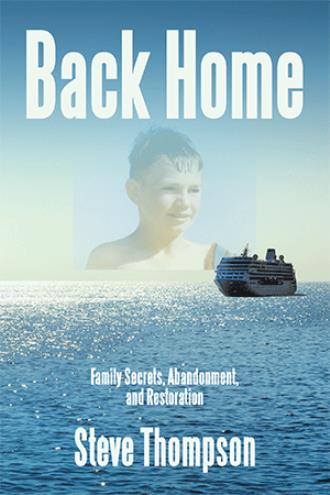
Back Home
Family Secrets, Abandonment, and Restoration
by
Book Cover & Preview Text
I ambled into the bedroom for some downtime before dinner. I sat at my computer playing patience mindlessly when the phone rang. Anne, my sister, asked me for a comment about my recent family reunion in Albury. “That must have been challenging for you,” she said, “having to face Margaret so long after your divorce, and the kids would be grown up by now too.” I told her that my recollection of the reunion weekend was beginning to fade. I agreed that the reconnection had been emotionally challenging, but there was more. I saw the entire interaction, from my apology to Sam and Blanche (my former parents-in-law) in Springwood, right up to the return trip from Albury, as a sequence that would reestablish my connection with my estranged family. “It wasn’t an emotionally charged meeting, like you would see in the movies, nor was it what I was expecting, but it had to happen,” I told her, referring to the drivenness of many years that had moved the reconciliation project along. “And it repaired some long-term damage to the family, giving me some closure on the most difficult years of my life.” I explained how our new family relationships were evolving in the few short months since the two sides of my family met up. I felt like a father to my first two kids again. There was no change to our lifestyles or the legal position, no moving back in, and no declarations of any kind, even though the kids had officially been legally adopted by someone else. Taking me by surprise, Anne asked, “Do you want to know who your father is?” “Sure,” I said, although uncertain because this was the first time I had heard that I might have a different biological father than my brothers and sister. I had always nurtured the bizarre impression of aloneness. There is no logical explanation for me to feel alone, but I can’t remember being part of my extended family before my car accident either. I have always felt like I was clinging to the outside of my nuclear family and looking in, watching the goings-on like a visitor. So, Anne’s comment resonated organically with me when she mentioned the possibility that I may have a different biological father than my siblings. I juggled the telephone receiver frantically into my other hand and reached for a pen. “There’s a family secret,” she said. “It’s about a bloke called Frank.” That news sent my head spinning. Is Frank still alive? I printed his name on the notepad, but other questions came to mind. Could this snippet of key information finally unlock the secrets of the forgotten years? Would I remember my life before the day I woke up in Wollongong Hospital? And is that even possible? The other issue, the question about where I belong, was more to the point. I had just been told of the secrecy I had always suspected, but it seemed too far-fetched to be taken seriously until now. So too did the sudden urge to discover once and for all where I fit into the fabric of this family. My disconnection feeling came back into view. Anne went on with her story about Frank. “He used to live with us in Manchester, and he lived over here in Melbourne for a while too, but he went back to England. They say he died a few years ago, and his wife moved to Wales.” This version of events was breaking news, and the intrusion of my questions took over. If Frank and I were in the same country at some point in time, possibly the same Australian state, why did he not attempt to contact me? So much for the moral stance and the family values that were meant to be commonplace in my extended family. What happened to that? There was a codifier that was implanted while we were young, to keep our developmental behaviours intact. Its purpose, among other things, meant that a family secret of a sordid nature like this one would never have been allowed to spread beyond the domestic border. Any alternative genealogy notion would have seemed too outrageous for me to consider seriously until now. Nevertheless, I have always thought differently from my siblings and parents—this may have something to do with the missing link that has plagued me since childhood. It’s reasonable to expect that the family secret hadn’t spread beyond the domestic border, but it had also bypassed me until now. Checking for validity, I asked, “How do you know all this stuff?” “The whole family knows except for you,” Anne said. “Grandma and Aunty Win used to say you are definitely Frank’s boy, because you look so much like him.” Frank Pilley was a name that had punctuated the Goodwin family discussions over the years, but I didn’t inquire about where he fitted into our narrative. Why are there no photographs of him or his family in our family archives? I recalled a discussion with Grandma not long before she died, in which she told me I “look like Frank Pilley”. She gave no explanation, but she was quite elderly and may not have realised she left an integral part of the story out. I excused her remark as senility, but maybe it was her subtle attempt to divulge the long-held family secret to me. Still, the questions in my mind kept challenging Anne’s news. After hearing about the confusion around my conception, it was easier to understand why I never struck up a father-son connection with John. Despite feeling comfortable with my domestic situation, intuitively, I accepted Anne’s version of the family narrative. However, impulsively, I wanted to go beyond the powerful link between the church and our family, to a place behind the solid façade where I could explore the latest information. Thereafter, I had to learn of Frank’s whereabouts, or at least meet his family and have them confirm our family secret from their side.
Select Format

Book Details
About the Book
Steve Thompson woke up in Wollongong Hospital soon after his fifth birthday, trying to understand what life was about, while drifting in and out of consciousness. Privately, he feared a nagging obsession that he didn’t belong there. Back Home is set in Australia and against a backdrop of English cultural history. Steve Thompson looks back at a childhood filled with family secrets. His family began emigrating from the United Kingdom to Australia in 1926 when the British government granted his uncle free passage to the continent. Over time the rest of the family followed, with the author arriving in 1951. Once there, he found his British and Christian background were considered handicaps by the Frogs Hollow working-class community. Almost a decade later, his parents’ marriage ended, and the family scattered. The author sunk into a deep depression and the damage echoed down to the next generation, contributing to his own divorce. Then, family secrets emerged. In this memoir, he reveals how he overcame obstacles, came to terms with the past, and sought to reconcile with loved ones.
About the Author
Steve Thompson was born in Reddish, United Kingdom. His parents were cotton-millers before immigrating to Australia with assistance from the British government after World War II.