

When Aphrodite Wept
A Story of Love, Exile and the Memories That Survived
by
Book Cover & Preview Text
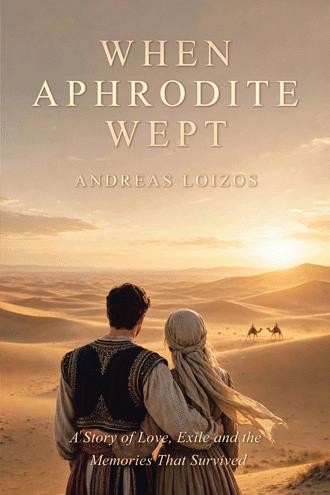
PROLOGUE Buried Truths and a Promise of Tomorrow Larnaca, Cyprus – 2019 For forty-five years, the biscuit tin had remained sealed. Its metal had darkened with age. Rust had gathered around the edges of the lid, and the faded decoration upon its surface had almost disappeared. To anyone unaware of its history, it might have appeared worthless—an ordinary household object that should have been discarded decades earlier. But the tin had survived because someone had understood what it contained. Its journey had begun during the summer of 1974, in the final hours before a family fled the village of Kontea. The Turkish invasion was spreading across Cyprus, reaching even its smallest and most isolated communities. Military vehicles moved through the village, while loudspeakers warned residents to leave immediately. There was little time to decide what could be taken. Most families left with almost nothing because they believed they would return within days. Doors remained unlocked. Beds were left made. Bread cooled upon kitchen tables. Animals waited in their enclosures for owners who expected to be home before they needed feeding again. In the courtyard of one farmhouse, beneath the roots of a jasmine bush, a biscuit tin was hurriedly buried. Inside it were objects belonging to an earlier generation—small possessions that had survived poverty, migration and the passing of empires. They could not be carried during the confusion of the escape, but neither could they be left where strangers might find them. The earth was pressed firmly over the hiding place. Then the family departed. Two nights later, while Kontea remained caught between abandonment and occupation, someone returned to the farmhouse. The journey was dangerous, but animals had been left behind and could not simply be forgotten. During that brief return, the tin was recovered from beneath the jasmine bush and carried away from the village. No one opened it. A promise had been made that its contents would remain undisturbed until the time was right. The tin was therefore hidden once more—not beneath the soil, but among the possessions and memories of a displaced family. Years passed. The farmhouse in Kontea slowly fell into ruin. The jasmine continued to grow beside the empty courtyard, its roots spreading through the place where the tin had briefly rested. Seasons passed over the abandoned house, and the village changed around it. The family did not return. The tin travelled with them into another life. It survived temporary accommodation, unfamiliar rooms and the difficult years during which displaced families attempted to rebuild what had been lost. Still, it remained sealed. The days became years, and the people who remembered why the promise had been made gradually disappeared. What had begun as a family secret became a memory spoken of only occasionally and then scarcely mentioned at all. Until 2019. Now the biscuit tin rested upon a table in Larnaca. Those gathered around it understood that opening it would not restore the house in Kontea or return the years taken from them. It would not undo the division of the island or recover everything the family had left behind. But it might answer questions that had survived for generations. The rusted lid resisted at first. When it finally came free, the smell of old paper and metal rose from inside. There were pieces of jewellery that had passed from mother to daughter, their soft gleam dulled by time. There were coins from another empire and another century, their edges worn smooth by the hands through which they had travelled. Beneath them lay a letter. It had been folded carefully. The paper was fragile and yellowed, but the faded handwriting remained legible. My beloved Marianthi, Our secret meetings have been a solace in this world that does not understand our love. I will wait for you before dawn at the chapel of Ayios Mamas, where no shadow will ever separate us again. Kyriacos The letter was dated 22 May 1896. More than a century had passed since those words were written. The people gathered around the tin knew that the names belonged to their family, but much of the story surrounding them had been lost. Only fragments remained: distant journeys, whispered disagreements, separations and the names of people whose lives had never been fully explained. Who were Kyriacos and Marianthi? Why had their love been forbidden? What happened after the letter was written? And why had their story remained hidden for so long beneath jewellery, soil and silence? The answers would lead back through the family’s history—through Cyprus and Turkey, across deserts and mountains, and into lands whose names had survived only in fading memories. They would reveal a young man who defied his father for love and a young woman who refused to allow deafness, poverty or the judgment of others to determine the course of her life. They would also reveal the cost of that decision. This story begins with a letter written in 1896, carried through generations and protected during a war. It begins with a biscuit tin buried beneath a jasmine bush. And with a family finally prepared to open it.
Select Format

Book Details
About the Book
WHEN APRHODITE WEPT In 1896 against empire and tradition two young lovers flee across Cyprus and the Levant. Their odyssey would shape history. A sweeping romantic saga inspired by true events.
About the Author
Andreas Loizos is a Cypriot-Australian writer whose life has been shaped by migration, farming, family and a deep connection to the land. For many years, he worked as a farmer in Darwin and Kalgoorlie, gaining an enduring respect for resilience, hard work and the quiet strength of ordinary people. He also worked in real estate in Kalgoorlie and Perth. After retiring, Andreas began writing and has now devoted almost eighteen years to developing stories inspired by history, family memory and lived experience. When Aphrodite Wept draws partly upon his family’s history, including Cyprus’s cameleer tradition, migration to Australia and the displacement caused by the division of the island. Blending research with inherited memory and imagination, Andreas writes about love, hardship and identity across generations. He believes the stories carried within families deserve to be preserved and remembered.