

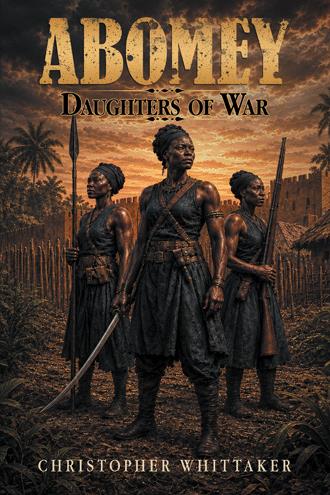
ABOMEY
Daughters of War
by
Book Cover & Preview Text
THE KING’S EYES Sena led them back towards the coast by a different route. They moved slowly, placing each foot carefully upon the damp earth. Smoke guided them towards the warehouse, thickening between the trees and catching in their throats. Sena selected a position upon raised ground overlooking the compound and the road from Cotonou. Dense foliage concealed them, but narrow gaps between the leaves provided a clear view of the ruins. “Here,” she whispered. They lay upon their stomachs beneath the broad leaves. Mud seeped into their wrappers. Mosquitoes settled upon their arms, and small ants found the gaps between clothing and skin. No one was permitted to move. Below them, the warehouse burned. Flames ran beneath the metal roof. Sections of timber wall collapsed inward, sending sparks high above the compound. The loading shelter had already fallen, and smoke rolled across the road towards the sea. The wounded French guard remained where Dòkpè had left him. He had dragged himself closer to the water flask and was trying to bind his leg with a strip torn from his shirt. The other surviving guard returned cautiously from the road. He carried no rifle. He approached the compound in short rushes, stopping repeatedly to search the jungle. When he saw the wounded man, he ran to him and knelt beside the shelter. Afi shifted her hand towards her musket. Sena touched the stock. “He has no weapon.” “He saw us.” “He saw many women.” “He can tell them which way we went.” “He can tell them we entered the jungle. Even a Frenchman could discover that without his help.” Afi looked towards the road. “We should have taken them with us.” “And carried two Frenchmen through the forest while their army searched for us?” Afi said nothing. Below, the surviving guard gave the wounded man water. He examined the bodies, then stood and looked towards Cotonou. Sika saw him make his decision. “He is going for help.” Sena did not look at her. “Watch where he goes.” The man ran along the coastal road. Kemi followed him with her eyes until the trees concealed him. “Towards Cotonou.” “How long until he reaches it?” Sena asked. Kemi hesitated. “Less than half a morning.” “Do you know that?” “No.” “Then what do you know?” “He ran south-east along the coastal road. He did not take a horse, and he carried no weapon.” “Better.” They waited. The sun climbed above the trees. Heat gathered beneath the leaves, trapping the smells of smoke, mud and their own bodies. Flies found them. Ants continued exploring Afi’s clothing with the persistence of an invading army. Below, the warehouse collapsed. The wounded guard attempted to move farther from the fire. He reached the open gate before exhaustion overcame him. Two porters emerged from the edge of the village. They approached with great caution. One carried a spear; the other held a long knife. When they recognised the wounded guard, they lowered their weapons and went to him. Together, they moved him beneath a palm away from the smoke. “They came back for him,” Sika whispered. “Why would they not?” Kemi asked. “The French clerk shouted at them.” “A man may dislike another man and still refuse to leave him beside a fire.” Sena turned her head slightly. “You are here to observe, not discuss the nature of men.” They fell silent. More people appeared from the village. Some had worked at the warehouse. Others had come to see what had happened. They kept away from the bodies at first. Eventually, a woman covered the dead guards with pieces of canvas. No one attempted to fight the fire. The warehouse was already beyond saving. The villagers waited beside the road. Shortly after midday, movement appeared through the trees from the direction of Cotonou. Kemi saw it first. “Soldiers.” Sena raised herself slightly. “How many?” Figures emerged along the road. Sika counted as Dòkpè had taught them. “Twelve.” “Again.” Sika counted a second time. “Twelve. Ten African soldiers, one French officer and another white man carrying a rifle.” “Uniforms?” “The African soldiers wear red caps. The officer has a sword and revolver. The other man is dressed like the warehouse guards.” The patrol approached cautiously. Four tirailleurs moved ahead of the others with rifles ready. They stopped whenever the road narrowed or vegetation came close enough to conceal an attacker. The remainder followed around the French officer. They did not rush towards their wounded comrades. They searched the ground first. Afi watched the leading tirailleur examine the place where the Agojie had crossed the road. “He has found our tracks.” “Perhaps,” Sena said. “He is looking at them.” “That is what you see. You do not know what he has understood.” The patrol reached the warehouse. The officer sent soldiers to both sides of the compound before entering through the gate. Two examined the bodies. Another questioned the wounded guard while a tirailleur translated. The surviving sentry demonstrated the attack with both hands. He pointed towards the jungle, the warehouse and the road. He imitated muskets firing and then indicated the direction in which Dòkpè’s women had withdrawn. The officer listened without interruption. “He is telling them where we went,” Afi whispered. “He is telling them where he believes we went,” Kemi replied. The French officer examined the ruins. He kicked through the ashes near the office and recovered part of the metal box which had contained the records. Then he knelt beside the guard Afi had killed. He examined the wound and looked towards the jungle. Afi became completely still. Sika could hear her breathing. The officer crossed to the wounded survivor. After questioning him, he summoned two soldiers. They fashioned a stretcher from rifles and a canvas sheet and lifted the man onto it.
Select Format

Book Details
About the Book
FRANCE CAME TO CONQUER DAHOMEY. THE AGOJIE WERE WAITING. The Agojie were Dahomey's elite corps of women soldiers—disciplined, feared and sworn to defend their king, kingdom and people. Based on true events, Abomey: Daughters of War is a powerful story of resistance, sisterhood and a kingdom that refused to surrender without a fight. From the author who brought you Heidenröslein: The Little Rose in the Heath
About the Author
Christopher Whittaker was born in Derry, Northern Ireland, and migrated to Australia with his family in 1961. He grew up in Canberra, where his lifelong fascination with history—particularly military history—was encouraged by dedicated teachers and frequent visits to the Australian War Memorial. Chris later served in the Australian Army Reserve and is now retired after a career in the disability sector. His passion for writing is driven by a desire to look beyond accepted historical narratives and explore the different perspectives, motivations and influences that shape events. He is particularly interested in questioning the version of history presented as settled truth, believing that while history may be written by the victors, the real story is often far more complex. Chris now lives in Ellenbrook, Western Australia, with his wife, Dianne, and their miniature poodle, Molly. Christopher Whittaker 2026 christopherwhittakerauthor.com christopherwhittaker1@christopherwhittakerauthor.com