

Why Are We Still Surprised?
Breaking the Silence Around Boys in Dance
by
Book Cover & Preview Text
Chapter Three - The Bridges We Refuse to Build Every stereotype we accept is a bridge we refuse to build. Not because we can’t build it, but because we’ve decided, consciously or not, that some people don’t need to cross. Stereotypes are easy. They ask nothing of us. No curiosity. No conversation. No accountability. Just assumption. I have sat in rooms where decisions are made about boys in dance without a single boy in the room. I have heard colleagues speak with certainty about who these boys are, what they represent, what they will become, as though movement is a diagnosis rather than an expression. “They’re probably…” “They tend to be…” “You know what boys like that are like…” And just like that, a bridge collapses before it is even built. Because stereotypes don’t just shape opinions, they shape opportunity. They decide which programs get supported and which are quietly sidelined. They influence which students feel encouraged and which ones feel exposed. They determine whether a boy walks into a studio with pride, or with a need to explain himself before he’s even begun. But these ideas don’t appear out of nowhere. They are learned. Repeated. Reinforced. I have seen it in playgrounds, not just in what is said, but in where it comes from. Words that are too sharp, too certain, too familiar to belong to a child alone. “That’s gay.” “Boys don’t dance.” “Why would you do that?” Name calling doesn’t begin as cruelty; it begins as imitation. It echoes conversations overheard at dinner tables. Comments made in passing. Jokes that were never challenged. And when those words land, they don’t just bruise, they shape behaviour. They teach boys to hide. They teach others to target what they don’t understand. They create an environment where difference becomes something to point at, rather than something to learn from. What we accept, we allow. And what we allow, we teach. I see it in the hesitation of a new student standing at the edge of the room. Not unsure of his ability, but unsure of his acceptance. I see it in the jokes that are brushed off as harmless, in the sideways glances, in the silence when someone should have spoken up. Because silence is its own kind of agreement. And the cost of that agreement is not abstract. It is carried by boys who learn to shrink their passion. By boys who choose sport over dance, not because they love it more, but because it is safer. By boys who never step forward at all. We talk about building inclusive communities, but communities are not built in statements, they are built in choices. In the moment you challenge a comment instead of letting it pass. In the moment you correct a narrative before it becomes belief. In the moment you teach not just your child, but every child, that respect is not optional. Bridges are not built by intention alone. They are built by action. Every time we question a boy’s place in dance, we widen the gap between who he is and who he is allowed to be. Every time we choose not to challenge that thinking, we stand on one side of the river… wondering why unity feels so far away. Assumptions built on stereotypes don’t just misjudge people, they fracture possibilities.
Select Format

Book Details
About the Book
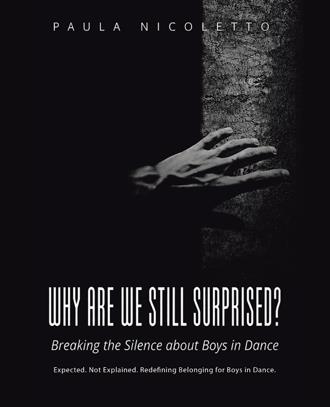
Why are we still surprised when a boy chooses to dance? Why Are We Still Surprised? Breaking the Silence Around Boys in Dance challenges the stereotypes, assumptions and unspoken expectations that continue to shape the experiences of boys in dance. Drawing on more than three decades in dance education, alongside her experiences as a teacher in an all-boys school and mother of two sons who dance, Paula Nicoletto explores what happens when passion collides with perception. From costume racks and classrooms to competitions, assessment practices, family expectations and the persistent pressure to appear “masculine,” the book exposes the subtle messages that can make boys question whether they truly belong. But this is not simply a book about boys. It is a conversation about the boxes we create for everyone—and what becomes possible when we dismantle them. Blending personal stories, research, reflection and practical strategies, Paula challenges educators, parents, studios and the wider community to reconsider the language we use, the systems we accept and the stereotypes we unintentionally perpetuate. Provocative, personal and ultimately hopeful, Why Are We Still Surprised? asks us to stop questioning why boys dance and start questioning why, in 2026, we still think their choice requires an explanation. Dance never had a gender. Our assumptions did.