

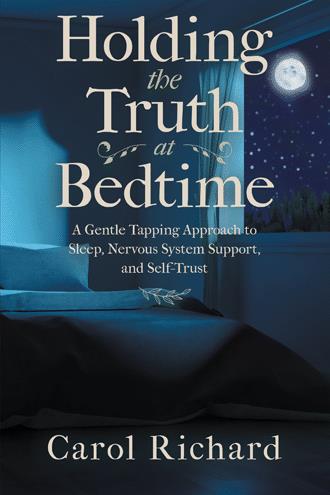
Holding the Truth at Bedtime
A Gentle Tapping Approach to Sleep, Nervous System Support, and Self-Trust
by
Book Cover & Preview Text
Introduction You Don’t Have to Lie to Yourself to Rest If you are holding this book because sleep has become hard, I want you to know this first: I believe you. I believe how exhausting it can be to lie in bed when your body will not let go. I believe how lonely it can feel when the rest of the world seems to be sleeping and you are awake with your thoughts, your fear, your frustration, your grief, your responsibilities, or the quiet ache of wondering why this is happening to you. And I want you to know something else. You do not have to lie to yourself to rest. You do not have to pretend you feel peaceful when you do not. You do not have to force yourself into calm or repeat words your body cannot believe yet. You do not have to move around what is real in order to become someone who sleeps well. We can begin with the truth. For many sensitive people, sleep is not only about sleep. Nighttime is often where everything we have carried throughout the day finally has room to be felt: the worry, the responsibility, the pressure, the emotions we pushed aside because there was too much to do, the needs we ignored because someone else needed us, and the feelings we were never taught how to make space for. By the time bedtime comes, the body may be exhausted, but the nervous system may still be holding so much. Maybe you are tired from being the capable one, the kind one, the responsible one, the person who notices everything, feels deeply, and keeps going because things need to be done and people need to be cared for. Maybe you have spent so much of your life offering support to others that you are no longer sure how to receive it yourself. And maybe, when the lights go out and the world becomes quiet, all of that comes into bed with you. If that is true, this book is not here to tell you that you are doing sleep wrong. It is not here to give you another list of things to perfect or make bedtime feel like one more place where you have to prove you are healing correctly. This book is here to help you feel seen. So many sensitive people quietly wonder whether they are the problem. They wonder if they feel too much, need too much, notice too much, or cannot handle life as well as other people seem to. But what if your sensitivity is not the problem? What if part of what has happened is that you have been living in a world that often does not make much room for sensitive nervous systems? From the time we are young, many of us are taught to override ourselves. Sit still. Be quiet. Follow the rules. Ask permission to use the bathroom. Hold it together. Be nice. Be good. Do not be too much. Do not feel too much. Do not need too much. Some of those rules may have had a purpose, but many of us learned very early to put our own needs aside. We learned to stay connected to the people and expectations around us, even when it meant becoming less connected to ourselves. Then one day, often in adulthood, the nervous system begins to say, I cannot keep doing this without support. Sometimes it says this through anxiety. Sometimes through exhaustion, stress, or a body that feels wired and tired at the same time. Sometimes it speaks through pain, tension, irritability, or the feeling that you cannot settle. And sometimes it says it through sleep. For me, sleep was the doorway. I came to this work because of my own lack of sleep. At first, I thought I had a sleep problem. But as I began to listen more deeply, I realized something much bigger was happening. I was a sensitive person trying not to be sensitive in a world that often felt too loud, too fast, too demanding, and too disconnected from the body. So yes, this book is about sleep. But it is also about coming back into contact with yourself. It is about becoming more whole. It is about learning to notice what is true, name what is true, and meet that truth with care rather than correction. This is what I mean by holding the truth. Holding the truth means I stop arguing with my own experience. It means I stop talking myself out of what I feel or rushing to tell myself that I should see things differently. It means I begin to notice and name what is happening inside me, even when I do not yet understand it or know what to do with it. For many of us, this is not easy at first. When you have spent years being corrected, dismissed, talked out of your feelings, or told to see things another way, you can lose contact with your own truth. You may not know what you feel. You may not know what you need. You may not understand what your body is trying to communicate. That is okay. We begin gently. Sometimes the first truth is simply, I am scared I will not sleep. Or, I am so tired of trying. Or, My body feels on guard. Or, I do not feel ready to let go tonight. Maybe the most honest truth is, I do not even know what I feel, but I know something in me needs care. That is enough to begin.
Select Format

Book Details
About the Book
What if better sleep does not begin with trying harder, forcing calm, or convincing yourself that everything is fine? In Holding the Truth at Bedtime, nervous-system-informed sleep coach Carol Richard offers a gentler way to meet the fear, frustration, racing thoughts, and emotional intensity that can arise at night. Through compassionate teaching, client stories, practical guidance, and Tapping scripts, readers are invited to understand sleep through a nervous-system perspective. Rather than treating wakefulness as a problem to fight, this book explores how honest acknowledgement, supportive language, and gentle tapping on points on the face and upper body may help create a different relationship with the body and with sleep. At the heart of the book is the Holding the Truth Tapping Method. Holding the truth means noticing and naming what is happening without arguing with the experience, believing every frightening thought, or placing forced positivity over it. Readers will find support for difficulty falling asleep, night waking, feeling tired but wired, obsessing about sleep, frustration, hopelessness, emotional activation, and fear of letting go. This book is not about performing healing correctly or making sleep happen on command. It is an invitation to move from pressure to relationship, from self-criticism to compassion, and from trying to control the nervous system to learning how to listen to and support it.
About the Author
Carol Richard is a nervous-system-informed sleep coach, EFT practitioner, author, and founder of the Better Sleep Community. Drawing from her own experience with insomnia, she helps sensitive people build a gentler relationship with sleep through Tapping, education, and compassionate nervoussystem support.