

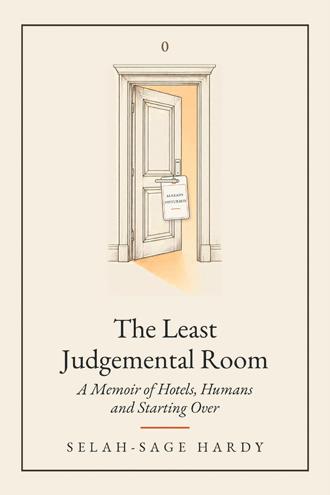
The Least Judgemental Room
A Memoir of Hotels, Humans and Starting Over
by
Book Cover & Preview Text
Chapter 1 — Human Beings at Large The Vargo family is not a family in the traditional sense. They are a gathering of every traveller I have encountered: the eccentric, the demanding, the curious, the lonely, the generous and the wonderfully bewildered. Mr Vargo carries our absurdities, Mrs Vargo collects our stories, and their ever-changing children embody the wonder with which we first discover the world. They arrive with baggage, questions, expectations and sometimes an emergency sock. They are not real, but each of them is true. Together, they represent humanity in motion, revealing who we become when we leave the familiar behind and place ourselves, however briefly, in the care of strangers. I met Mr Vargo on a Tuesday, though he insisted it was Thursday. He arrived with no luggage, no booking, and no memory of how he got there. He wore a bathrobe — his own, not ours — and carried a single sock in his pocket “for emergencies.” He asked for Room 0. Said it was the only one that didn’t judge him. In nearly two decades in housekeeping and hospitality, I’ve met versions of him in every room. The guest who demands a refund because the moon was too bright. The one who leaves a tip in Monopoly money. The one who writes a complaint in haiku. The one who insists the minibar is a metaphor. Mr Vargo is the embodiment of human absurdity at large. He is brilliant and clueless, kind and cruel, lonely and performative. He is what happens when intelligence outpaces wisdom, when comfort breeds chaos, when the pursuit of meaning becomes a scavenger hunt with no prize. This book is not about Mr Vargo. But he will be here — lurking in the hallway, whispering through the vents, leaving philosophical graffiti on the bathroom mirror. He is the ghost of unchecked-in humanity. The patron saint of misplaced genius. The sock in the pocket of civilisation. He checked in without checking in, appearing in the breakfast room the next morning, sipping orange juice from a wine glass and critiquing the existential despair of the buffet layout. “Croissants should never be arranged in even numbers,” he said. “It implies a symmetry that life cannot sustain.” No one argued. We’ve learned not to. In hospitality, you develop a sixth sense for when a guest is not looking for answers, just an audience. Mr Vargo was performing for the scrambled eggs. Later that day, I found him in the linen cupboard, reorganising the towels by emotional temperature. “These ones feel like regret,” he said, stroking a beige bath sheet. “These are more… cautious optimism.” He was right, oddly. The regret towels were always the ones that came back damp and slightly sour, no matter how hot the wash. The average hotel guest uses 2.3 towels per night. The .3 is usually the hand towel they use once and leave in the sink like a tiny, damp flag of surrender. Mr Vargo never used towels. He claimed to air-dry by standing in a sunbeam and reciting Rilke. When I asked how he managed on cloudy days, he said, “That’s when I use the emergency sock.” He left notes. Not requests — those are too pedestrian for a man like Vargo. These were riddles, koans, sometimes just single words written in lipstick on the mirror: “Unfold.” “Beware the complimentary pen.” “Room service is a state of mind.” I once found a note tucked under the mattress: “The real minibar is the friends we made along the way.” I kept that one. It made more sense than most of the TripAdvisor reviews. The most stolen hotel item is not towels or robes — it’s batteries from the remote. Followed closely by the remote itself, which guests apparently believe is a universal souvenir. Mr Vargo never stole. He borrowed reality and returned it slightly altered. He never stayed more than three nights. That’s the Vargo limit. Long enough to unsettle the rhythm of the place, short enough to vanish before the spell breaks. When he left, he didn’t check out. Just left the sock on the pillow, folded into the shape of a question mark. I’ve worked in five-star resorts and remote island properties, at the edge of the reef and in towns that barely wake. I’ve scrubbed lipstick off ceiling fans and found love letters in the minibar. But it’s the Vargos I remember. The ones who remind you that hospitality isn’t about thread count or turndown service. It’s about holding space for the strange, the lost, the luminous. And maybe, just maybe, about learning to read the signs when a sock appears where logic should be.
Select Format

Book Details
About the Book
The Least Judgemental Room invites readers to step inside the living metaphor of the hotel — a place of arrivals and departures, hidden labour, fleeting encounters, and quiet transformation. The book explores hospitality as a mirror of life’s journey: rooms are entered and left behind, corridors hold untold stories, and every act of care becomes part of a larger human passage. By weaving together personal experiences with imaginative storytelling, this book offers a fresh perspective on what it means to find wisdom in the ordinary and dignity in the overlooked. Blending memoir, fiction, humour, and reflection, it challenges readers to reconsider their own journeys, encouraging empathy and appreciation for the unseen labour and quiet grace that underpins the world of travel. In doing so, it invites all who wander — and those who welcome them — to recognise the extraordinary in the commonplace.
About the Author
Selah-Sage Hardy spent nearly twenty years in Australian hotel housekeeping, working her way from room attendant to executive housekeeper, head of department and operations manager. Most of those years were in resorts and remote island properties in the far north, managing the teams, laundries and long shifts that happen behind a door marked Staff Only. She came to the industry while starting over, and found in it a place where hard work, humour and paying attention to people counted for something. The Least Judgemental Room draws on what those years taught her, braided with an invented hotel and its unforgettable guests.