

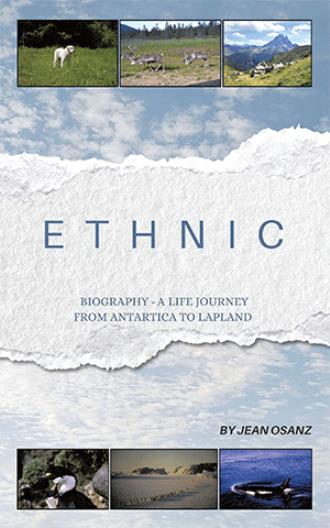
Ethnic
Biography - A Life Journey From Antartica to Lapland
by
Book Cover & Preview Text
Marcelina and Francisco Osanz crossed the Pyrenees on foot some time at the end of the 19th century. Monarchists at the wrong time, they were refugees fleeing the Republicans who had seized power in Spain. They settled in a village called Louvie-Juzon, not far from the border, and had four kids. Francisco was a miner and I guess Marcelina was a housewife. Plenty of work raising four children. I can’t remember the name of the four. There were two daughters who migrated to America in their twenties. One became a nun, the other one married a man named O’Gorman. I guess it was cool for an Irish catholic guy to marry a Spanish catholic girl. I am not too sure when Francisco died. I know he died young because he suffered from miners’ emphysema. Marcelina died around 1930, I guess, since my mother Noëlle, born in 1927, remembered the formidable woman she was. The two boys stayed in France. Noël became a priest. Augustin (my grandfather) received a good education from the Catholic Brothers in the college of San Sebastian, Spain. He was totally bilingual and became a primary teacher for a short time (maybe two years). World War I promptly interrupted his career in education. Aged twenty, he was sent to the front as a simple private and ended up in the trenches. Four years and eleven million dead later, he was a captain. After a particularly bold and bloody action during which most of his men got slaughtered, he fully expected to be court-martialled. Instead, to his great surprise, he received his “Légion d’Honneur” on the front line, from the hands of Marshal Nivelle (aka the Butcher of Verdun), the then commander in chief of the French forces. Later in the war, he sent his own brother Noël to his death. Noël was eight years his senior but still a private and a priest. Augustin never recovered from the grief. This is probably why he became a pacifist of sorts in his later years. Instead of crossing the Pyrenees, my grandmother’s parents, the Girards, migrated from France to California, also at the end of the 19th century. I know a lot less about them. They had two daughters, Marie and Louise. Marie was a dragon and Louise was an angel. She later became my grandmother. She was born in San Francisco and her papers were lost in the fire that followed the 1906 earthquake. Her father contracted some terminal disease and was treated by a Native American medicine man, but to no avail. The family returned to France as he wanted to die there. My grandmother Louise still had vague memories of sailing across the Atlantic. They settled in a town called Oloron, not far from Louvie-Juzon. With ancestors like that, it is not surprising that later in my life, I decided to become an Ethnic as well and migrated to Australia. It is in my genes. But this is a long story! I guess Augustin Osanz and Louise Girard met around 1920. They got married and had four children. Marcelle was born in 1922, Jeanne in 1924, Noëlle, my mother, in 1927 and François in 1929. Augustin was supposed to support his parents, his wife, four children and a number of dogs. He more or less did that by becoming a civil engineer, building roads and bridges. At that time, with most of the male population decimated by the war and the women in the kitchen, a man could do just about anything with or without the proper qualifications. Besides, he had a natural ability to manage people and was extremely resourceful. So this activity kept the tribe fed, if not rich. They all lived in a nice house in Louvie Juzon. The Spanish civil war broke out in 1936 and another wave of Spanish refugees crossed the Pyrenees. This time they were Republicans running away from Franco. But Republicans or not, many found a temporary refuge in the Osanz house. Louise managed to feed them along with the family and the dogs. World War II put an end to this. No more roads or bridges to build and no more food to buy. So, Augustin decided that he had to grow his own. He re-invented himself (again)…and became a farmer. He rented out the nice house in Louvie-Juzon and leased a farm in a remote village about 80 km North of Pau, Lussagnet. In these hard times he managed to feed the family with the help of several labourers he hired. He didn’t believe in getting his hands dirty so he used to hire local guys to do most of the work. To the end of his life he made good use of his management skills. The Liberation must have been a great period for most French people but the Osanz family fell apart soon after. Jeanne got married, got a job as a primary teacher and was posted in a remote village in the Cevennes. Not too traumatic so far. François had two severe nervous breakdowns and needed psychiatric treatment for a while. Noëlle met a friend of François called Pierre and soon got pregnant. In those days it was not right to be a single mum so Augustin promptly kicked her out. My father’s parents did not want me either, they decided that Noëlle should go to Switzerland where abortion was legal and to have it done there. She told everyone to get lost and decided to live her own life as a dressmaker in Pau.
Select Format

Book Details
About the Book
This book is about an ethnically diverse engineer who became spiritually aware. It is the story of his life on the physical, emotional, mental and spiritual levels, and from Antarctica to Lapland. Jean Osanz was born and educated in France. His single mother was the grand-daughter of Spanish refugees. He didn’t climb Mt Everest like Sir Edmund Hillary, but he was the first to reach the bottom of one of the deepest caves in the world at the age of 19. That’s physical. Then he became an engineer. That’s mental. He didn’t go to South Pole like Sir Edmund, but he still went to Antarctica where he met Pascale in 1979. That was very emotional. They got married, had two sons and have lived in Australia ever since. It is impossible to live with Pascale without getting some spiritual awareness. It’s called osmosis. Besides, Jean Osanz travelled for his work to 45 countries and trained some 300 scientific instruments field service engineers. He ended up having spiritual experiences all around the world, especially in India, Tibet and Peru. Like Sir Edmund in Nepal, he became a bit spiritual. He is now retired and lives in Rylstone, Australia. That gives him plenty of time to write his memoirs.
About the Author
Born and educated in France, Jean Osanz is an engineer who met Pascale, the woman who became his wife, in Antarctica. She gave him two sons and became his spiritual guide. Thanks to Pascale, Jean became an engineer with spiritual awareness. They have lived together in Australia since 1980.