

“I Don’t Know How You Did It,” A Mindful Approach to Career Transition
One Woman's Story of Navigating Career Change and Life Turbulence with Resilience and Inner Peace
by
Book Cover & Preview Text
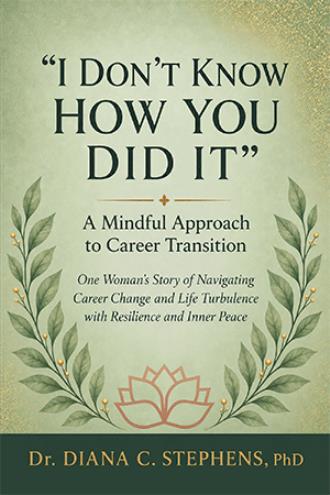
“I don’t know how you did it,” my cousin’s wife said quietly as I lay in a hospital bed recovering from pulmonary embolisms, blood clots caused by a cancer medication. She was referring to my resilience, the ability to keep moving forward through adversity. It was 2015. I was recovering from breast cancer and the treatments that followed. In many ways, the remedy felt worse than the sickness itself. Over the years, my family had watched me navigate a series of difficult chapters: my father’s death when I was 26, health challenges, job downsizings, and the slow and heartbreaking decline of my mother from Alzheimer’s disease. My cousin’s wife had witnessed much of that journey firsthand at family gatherings. Her words stayed with me. A few years later, I mentioned that quote to Tama Kieves, an author who had spoken at my church. After hearing the story, she smiled and said, “That would make a great title for your book.” But the idea lingered. Now, nearly a decade later, those words have found their way to the cover of this book. This book is my attempt to answer “How did you do it?” This is not just another book about the job search. It is a story of how seven job losses over 25 years shaped my mid-life spiritual journey and taught me valuable lessons I want to share with you. I learned how to cope and be more resilient, and you can too. This book is not just another “how-to” guide on résumés, LinkedIn profiles, interviews, or networking. While I share practical tools in Part Three, this book is primarily about the emotional and spiritual side of job loss, about what happens to our identity, confidence, and sense of purpose when work disappears, and about the practices that can steady us through those storms. It is also about how to cope with the job storms that come along with the illness issues, financial crises, and family chronic illnesses and eldercare. Life’s challenges come in groups, and this book gives you resources on how to cope. In addition to my private coaching practice, I work in outplacement for a global firm and coach clients daily on resumes and career transitions. At the time of this writing, I have had a dozen clients pause their job searches due to eldercare issues. Parents who have had the episode that turned the family upside down, then scramble to find care and get the paperwork in order. These issues always come in groups. The deeper question becomes how to manage personal crises during a job search. Society often assumes that the correct response to job loss is to rush out and secure the next paycheck. However, a job search is rarely only about money. It is about grief, transition, and resilience. It is about who we are when the roles we have held fall away. Author Bruce Feiler, in his book Life is in the Transitions, calls these moments “lifequakes,” disruptive clusters of crises that collide and leave us shaken, often for years. My own lifequake was not a single event, but a 16-year “dark night of the soul.” From 1999 to 2016, I faced my mother’s decline and passing from Alzheimer’s, two personal major surgeries, including breast cancer, two bankruptcies, the loss of my home, and seven corporate downsizings over 15 years. Sometimes these events arrived one after another, sometimes in pairs, but always with the weight of uncertainty. As Thomas Moore describes in Dark Nights of the Soul, such trials go beyond temporary setbacks; they become transformative passages that reshape the soul. Before I take you into those years, let me share a glimpse of my life before the storm. I grew up in the Midwest as an only child, the daughter of an engineer by day and a professional mentalist by night, and a devoted piano teacher mother. Ours was a household filled with both discipline and wonder, Catholic devotion on one side, agnostic curiosity on the other. By the time I was three, I was at the piano; by fifteen, I was studying classical voice. I earned both a Bachelor’s and a Master’s degree in Voice and performed with a regional opera company. In midlife, I sang with the Chicago Symphony Chorus for 11 years. As a child, my father even included my mother and I in his magic act, exposing me to performers, metaphysical thinkers, and spiritual seekers from an early age. Those encounters planted seeds of spiritual curiosity that I would only come to understand decades later. My dark night began in earnest with my mother’s decline and my own health crises. Caregiving, financial strain, and repeated job losses left me exhausted. I often asked myself and God, Why me? Then came the turning point. In the fall of 2006, I found myself sitting cross-legged on the floor of a Reiki class. At that point, I was weary from years of loss and upheaval. That afternoon, as the Reiki Master guided me through the attunement, something shifted. A calmness came over me, the kind I had not felt in years. My breath slowed, my body softened, and in that quiet moment, I realized: healing was not only physical or financial. It was spiritual. That experience marked the beginning of my own journey toward mindfulness, inner alignment, and peace. Over the years that followed, Reiki, meditation, journaling, and mindful practices became my anchor. They steadied me through illness, bankruptcy, and repeated downsizings. They gave me the strength to move to New York City for work, then return home when my mother’s care required my presence. They carried me through her passing, and through the grief and renewal that followed. Most importantly, they gave me perspective. What felt like endless endings eventually revealed itself as a journey of transformation. I began to see that these crises were not punishments, but rather passages, opportunities to cultivate resilience, trust, and the ability to find stillness in the storm.
Select Format

Book Details
About the Book
Career transitions are rarely only about work. They often arrive alongside grief, uncertainty, burnout, health challenges, or major life changes that force us to reevaluate who we are and what truly matters. In I Don’t Know How You Did It, Diana C. Stephens shares a mindful approach to career transition that blends emotional healing, spiritual reflection, and practical career strategy. Through topics such as grief processing, meditation, journaling, Reiki, values clarification, purposeful networking, and mindful résumé writing, readers are guided through both the inner and outer dimensions of career change. Grounded in the framework of the Three-Legged Stool of Career Alignment — Mindset: Body, Mind, Spirit; Method: Professional Presence & Branding; and Market: The Uncontrollables — this book offers a compassionate path for navigating uncertainty with greater resilience, clarity, and purpose. More than a guide to finding work, this book is an invitation to create a life and career that feel more deeply aligned with who you are becoming.
About the Author
Diana C. Stephens, PhD, is the founder of Mindful Job Alignment, a coaching practice that helps professionals navigate career transitions with clarity, resilience, and purpose. Before launching her coaching practice, Diana spent many years working in corporate environments, gaining firsthand experience with the pressures, uncertainties, and unexpected disruptions that often shape modern careers. Over time, those experiences led her to explore a more holistic approach to career transition, one that integrates practical job-search strategies with emotional resilience, mindfulness, and personal reflection. Diana holds a PhD in Holistic Coaching, where her research focused on developing a mindful approach to job search and career change. Her work blends traditional career tools such as résumés, LinkedIn strategy, and networking with practices that support inner stability, including meditation, journaling, and spiritual reflection. Through Mindful Job Alignment, Diana works with professionals who may appear successful on the outside yet feel misaligned, burned out, or uncertain about their next chapter. Her approach helps individuals reconnect with their strengths, clarify their direction, and navigate career transitions with greater confidence and balance. Diana lives in the Chicago area, where she writes, coaches, and speaks about career alignment, resilience, and mindful living. Learn more at www.mindfuljobalignment.com Connect with Diana on LinkedIn linkedin.com/in/dianacstephens